Best Saree Storage Ideas for Your Wardrobe in India
Disclaimer: This article may contain affiliate links. If you purchase through these links, I may earn a small commission as an Amazon Associate—at no additional cost to you.
Quick Answer
The best saree storage ideas for Indian wardrobes include individual non-woven fabric bags with a transparent window for each saree, flat stacking with label tags, rolling method for cotton and silk, saree hangers for georgette and chiffon, and dedicated saree boxes for wedding and special occasion pieces.
Sarees are among the most difficult garments to store well. They are long, varied in fabric weight and texture, prone to creasing, and often expensive enough to justify careful handling — particularly silk and embroidered pieces. Yet in most Indian homes, sarees are stacked in an almirah without any system, meaning you spend five minutes hunting for the right one before every occasion, and delicate fabrics get damaged by contact with other sarees. This guide offers a complete saree storage system for wardrobes of every size.
Why Saree Storage Deserves Its Own System
Unlike other clothing, sarees present three specific storage challenges. First, they vary enormously in weight and texture — from 400-gram georgette to 2-kilogram Kanjivaram silk — meaning different fabrics need different storage methods. Second, they are usually stored without being worn for months at a time, making dust protection and humidity control important. Third, most Indian wardrobes are not designed with sarees in mind, and the standard shelf-fold system causes permanent crease lines in expensive fabrics.
8 Saree Storage Ideas for Indian Wardrobes
1. Individual Non-Woven Fabric Saree Bags
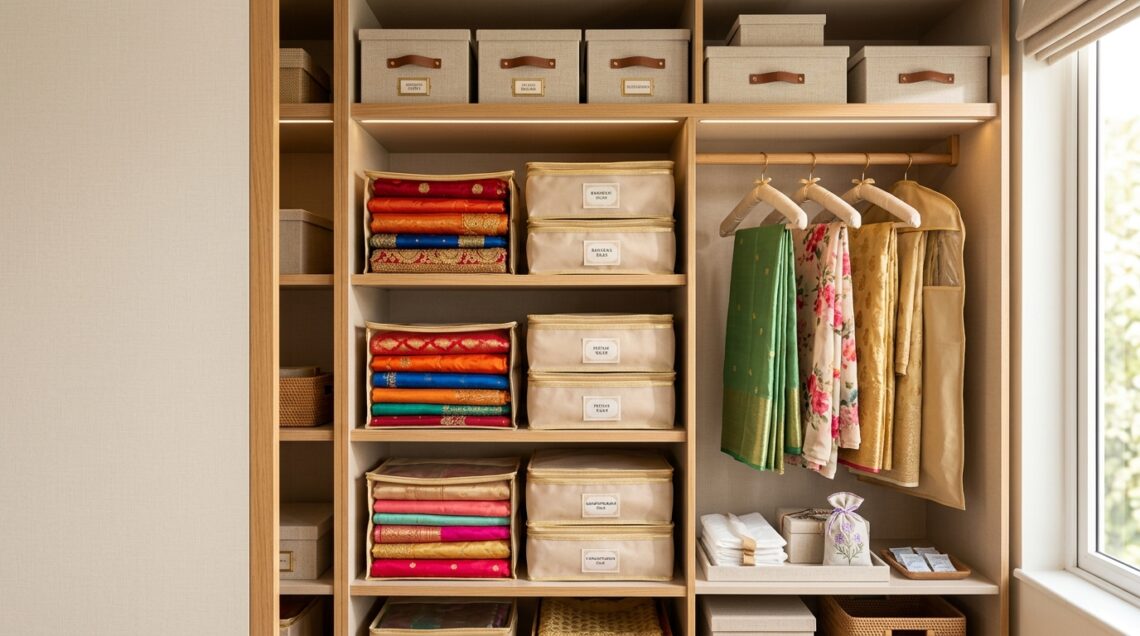
The single most impactful saree storage purchase is individual storage bags for each saree. Non-woven fabric bags — the soft, breathable material used for premium shopping bags — protect each saree from dust, prevent different fabric finishes from snagging on each other, and with a clear window or name tag, allow you to identify each saree without opening the bag. Stack the bags flat on a dedicated shelf. Available in sets of 6 or 12 for ₹200 to ₹500 on Amazon.in. Buy enough bags for your entire saree collection.
2. The Rolling Method for Cotton and Casual Sarees
Rolling rather than folding reduces sharp crease lines. For cotton, linen, and lightweight casual sarees that you wear frequently, roll them around a thin paper or fabric roll (cut to the saree’s width) and place the rolls vertically in a box or drawer organiser. You can see all rolls at a glance without unfolding, and accessing one does not disturb the rest. This method is particularly effective for daily-wear cotton sarees.
3. Flat Fold with Tissue Paper for Silk Sarees
Kanjivaram, Banarasi, Mysore silk, and other heavy silk sarees need flat fold storage with acid-free tissue paper between each fold to prevent sharp crease lines. The tissue paper cushions the fold and prevents the zari work from cutting into the fabric. Re-fold silk sarees along different lines every 6 months to prevent permanent creases. Store in individual saree bags away from direct sunlight. Never store silk sarees in plastic bags — they need air circulation.
4. Saree Hangers for Georgette and Chiffon
Georgette, chiffon, and other lightweight flowing sarees are prone to developing sharp fold lines that are difficult to remove with normal ironing. Hanging these sarees on padded saree hangers prevents creasing entirely. Padded saree hangers — wider than standard hangers to support the full drape of the saree — are available for ₹200 to ₹600 on Amazon.in. Hang them in a section of the wardrobe dedicated to sarees that need hanging storage.
5. Dedicated Saree Shelf with Dividers
If your wardrobe has adjustable shelves, dedicate one full shelf exclusively to sarees. Add vertical shelf dividers to create 4 to 6 sections on the shelf, each holding one category: daily cotton sarees, office wear sarees, occasional sarees, and silk or wedding sarees. This eliminates the need to search through an entire pile to find one specific saree. Acrylic shelf dividers are available for ₹200 to ₹400 for a set of four.
6. Saree Boxes for Wedding and Special Occasion Pieces
Wedding sarees, gifted silk sarees, and expensive occasion wear that is rarely worn deserve dedicated box storage. Saree storage boxes — rigid boxes with a liftable lid and soft lining — protect delicate fabrics better than bags or open shelves. Store one saree per box with acid-free tissue paper, and add a small lavender sachet or neem leaf packet inside to deter insects. Label the outside of the box with the saree name or occasion. Available for ₹300 to ₹1,000 per box.
7. Under-Shelf Hanging Saree Organiser
An under-shelf hanging organiser — a row of hooks or a fabric drape holder that clips to the underside of an existing shelf — allows you to hang 5 to 10 sarees by their pallu in a small space without using floor or shelf space. Particularly useful for frequently worn sarees that you want immediately accessible. Available for ₹200 to ₹500.
8. Seasonal Rotation and Labelling System
The most sustainable saree storage system combines physical storage with a rotation system. Store current-season sarees on accessible shelves. Move less-frequently-worn sarees — heavy silks in summer, lightweight cottons in winter — to upper shelves or under-bed storage boxes. Label each group clearly. This keeps your most-accessed sarees at hand height and prevents the full collection from overwhelming the available space.
How to Store Different Types of Sarees
Cotton and linen sarees: roll or fold and store in breathable non-woven bags. Can handle flat stacking.
Silk sarees (Kanjivaram, Banarasi, Mysore): flat fold with tissue paper at every fold, individual non-woven bags, never plastic.
Georgette and chiffon: hang on padded saree hangers or roll gently. Avoid heavy stacking that crushes the drape.
Synthetic and semi-synthetic (polyester, art silk): fold and bag. Less prone to crease damage but benefit from dust-free storage.
Embroidered and zari-work sarees: wrap in muslin cloth before bagging to prevent zari from snagging on other fabric.
Monsoon and Humidity Protection for Sarees
India’s monsoon season is particularly hard on silk and embroidered sarees. Humidity can cause discolouration in silk, mildew on cotton, and tarnishing of zari work. During June to September: take silk sarees out of storage, air them in indirect sunlight for 2 to 3 hours, then re-fold and return them to storage. Add two or three silica gel packets on the saree shelf and replace them every 2 months during monsoon season. Never spray perfume directly onto a stored saree — the alcohol in perfumes damages silk fibres over time.
Saree Storage Checklist
- Buy individual non-woven saree bags for every saree in your collection
- Separate sarees by fabric type: cotton, silk, georgette, synthetic
- Use acid-free tissue paper between folds for silk and zari-work sarees
- Hang georgette and chiffon sarees on padded hangers
- Store wedding and occasion silk in labelled saree boxes with tissue
- Add silica gel packets on the saree shelf, replace every 2 months in monsoon
- Air silk sarees in indirect sunlight once every 3 months to prevent yellowing
- Re-fold silk sarees along different fold lines every 6 months to prevent permanent creases
Final Thoughts
Your saree collection represents significant emotional and financial value. A dedicated storage system — individual bags, correct folding for each fabric type, humidity protection, and seasonal rotation — protects that investment and ensures every saree remains accessible and wearable for decades. Start with individual non-woven bags for each saree and a dedicated shelf section, and build from there.
For complete wardrobe organisation including sarees and daily clothing, read our guide on the best wardrobe organisation ideas for Indian homes.
Frequently Asked Questions
How should silk sarees be stored in an Indian wardrobe?
Fold silk sarees with acid-free tissue paper between each fold, then store in a breathable non-woven fabric bag — never plastic, which traps moisture. Place on a dedicated shelf away from direct sunlight and add silica gel packets nearby. Re-fold along different lines every 6 months to prevent permanent crease marks.
How do I prevent sarees from getting musty in the monsoon?
Air all sarees in indirect sunlight for 2 to 3 hours before the monsoon season begins. Place silica gel packets on the saree shelf and replace them every 2 months during June to September. Ensure the wardrobe is not against an exterior wall that may absorb moisture.
Can I store sarees in plastic bags?
Avoid plastic bags for silk and natural fibre sarees. Plastic does not breathe, trapping moisture inside that causes mildew and discolouration over time. Use non-woven fabric bags with a zip closure for all saree types — they protect from dust while allowing air circulation.
How do I organise a large saree collection in a small wardrobe?
Use the seasonal rotation system: keep current-season sarees on accessible shelves and move others to under-bed storage in labelled flat boxes. Within the wardrobe, use shelf dividers to create sections by category. Individual saree bags allow you to stack more sarees in the same space without damage.
What is the best way to prevent zari from tarnishing on stored sarees?
Wrap zari-work sarees in muslin cloth before placing in storage bags. Keep them away from humidity and store in a cool, dry place. Avoid contact with perfumes, deodorants, and synthetic fabrics. Occasionally air them in dry indoor conditions to remove any residual moisture.
Should sarees be washed before storing for a long period?
Yes — always store sarees clean. Stains, perspiration, and food residue can set permanently over months in storage, attract insects, and cause fabric discolouration. For silk sarees, use dry cleaning services before long-term storage rather than home washing.
How do I store a Kanjivaram saree safely at home?
Fold the Kanjivaram saree with acid-free tissue paper at each fold. Wrap in plain muslin cloth (avoid coloured fabric that may transfer dye). Store in a dedicated saree box or a non-woven bag away from direct light and humidity. Air it in indirect sunlight once every 3 months.