Best Spice Storage Solutions for the Indian Kitchen
Disclaimer: This article may contain affiliate links. If you purchase through these links, I may earn a small commission as an Amazon Associate—at no additional cost to you.
Quick Answer
The best spice storage solutions for Indian kitchens include a stainless steel masala dabba for daily-use spices, wall-mounted spice racks for frequently reached spices, airtight glass jars for bulk spices, and labelled tiered drawer organisers. The right system depends on your kitchen size, the number of spices you use, and whether your counter space is limited.
The average Indian kitchen uses between 20 and 40 different spices and masalas regularly, far more than any kitchen in the world. From haldi and jeera to garam masala, chaat masala, kasuri methi, and hing, the sheer variety of Indian spices makes storage a genuinely complex challenge. Too many cooks live with a chaotic spice cabinet where packets are stacked on packets, older spices are buried at the back and forgotten, and the daily act of finding the right masala while cooking becomes a frustrating hunt. This guide solves that for every kitchen size and every budget.
Why Spice Storage Matters in an Indian Kitchen
Poorly stored spices lose potency faster. Spices exposed to heat, light, or moisture deteriorate within months. In an Indian kitchen where whole spices like cardamom and cloves can cost ₹800 to ₹2,000 per 100 grams, and where fresh masala powders like Kashmiri red chilli can run ₹500 to ₹1,200 per kilo, wasting spices through poor storage has a real monetary cost. Additionally, a well-organised spice system saves 3 to 5 minutes of searching during every single cooking session, adding up to meaningful time savings over a week of daily cooking.
The Two-Tier Spice System: Everyday vs. Occasional
The most practical approach to Indian spice storage is a two-tier system. Tier one holds the 8 to 12 spices used in almost every meal: haldi, red chilli powder, coriander powder, cumin powder, garam masala, mustard seeds, jeera, and salt. These go in your masala dabba or the most accessible part of your spice setup. Tier two holds the 15 to 30 occasional spices, ajwain, fenugreek seeds, hing, dry mango powder, chat masala, black cardamom, and so on. These go in a dedicated shelf, drawer, or cabinet, sorted by frequency of use.
7 Spice Storage Solutions for Indian Kitchens
1. The Stainless Steel Masala Dabba
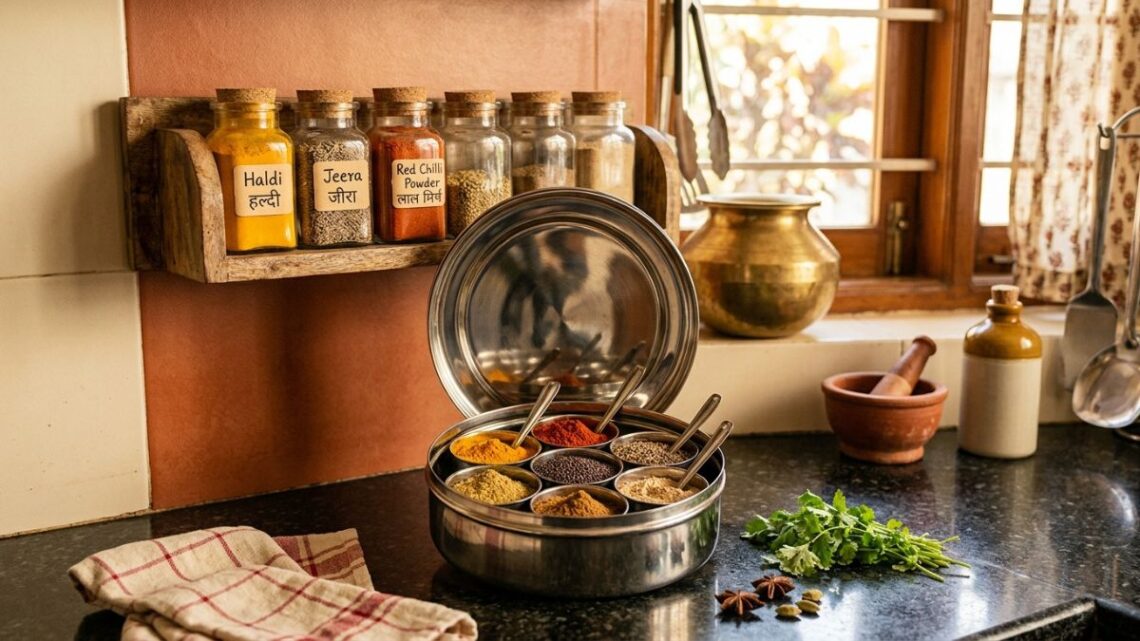
The masala dabba, a large flat stainless steel container with 7 smaller containers inside, is the original Indian spice storage solution, and it remains the most efficient for daily-use spices. Everything is visible and accessible in one lift of the lid, and the spoon is stored inside. A good quality stainless steel masala dabba costs ₹400 to ₹1,200 and lasts decades. Two dabbas, one for whole spices, one for powders, cover virtually all daily cooking needs for a family. Keep the dabba near the stove, not in a cabinet.
2. Wall-Mounted Spice Rack
Wall-mounted spice racks free up counter and shelf space completely. They are ideal for apartments and kitchens with limited cabinet depth. Magnetic wall-mounted racks hold spice jars on a magnetised strip. The jars are visible, accessible, and look neat on the kitchen wall. Traditional tiered wall racks in stainless steel or powder-coated iron hold 12 to 24 bottles. Available on Amazon.in for ₹400 to ₹1,500 depending on size and material. Wall-mounted options work best for the 12 to 15 spices you reach for most frequently.
3. Airtight Glass Jars for Bulk Spice Storage
Whole spices and bulk masala powders bought in large quantities, such as jeera, dhania seeds, black pepper, and haldi powder, keep best in airtight glass jars away from heat and light. Glass is preferable to plastic because it is non-reactive (important for pungent spices like hing and ajwain), easy to clean, and allows you to see quantities at a glance. A set of 12 to 24 airtight glass jars with bamboo or steel lids is available on Amazon.in for ₹600 to ₹2,000 for the full set. Label each jar clearly with the spice name and the date it was filled.
4. Pull-Out Spice Drawer Organiser
For kitchens with drawer space, a tiered pull-out spice organiser is one of the most satisfying solutions. Tiered inserts allow spice jars to be stored at an angle so labels face upward, you can see every jar immediately when you open the drawer without lifting anything. These inserts are available for ₹600 to ₹1,500 and can be cut to fit drawer dimensions. Best for: kitchens where counter and wall space is limited but drawer depth is available.
5. Turntable (Lazy Susan) Inside Cabinets
A turntable placed inside a spice cabinet solves the problem of items at the back being permanently out of reach. Spinning the turntable brings every jar to the front without reaching. Stainless steel or acrylic turntables are available for ₹300 to ₹700 on Amazon.in. A double-tier turntable holds 20 to 30 spice jars. Best for: deep kitchen cabinets where back-of-shelf items are frequently lost.
6. Hanging Pocket Organiser for Sachets and Packets
Many Indian spices are bought in plastic sachets or small packets, such as whole cardamom, bay leaves, star anise, and dried red chillies. These do not store well in jars because the quantity is too small to fill a jar. A fabric hanging pocket organiser attached to a cabinet door holds these sachets neatly and keeps them accessible. Available for ₹200 to ₹500.
7. Labelled Tiered Shelf Risers Inside Cabinets
Shelf risers placed inside spice cabinets create two levels of storage within a single shelf height, doubling the number of jars visible at once. Combined with labelled jars, this turns a chaotic spice cabinet into an organised, accessible system. Acrylic or bamboo shelf risers designed for cabinets are available for ₹300 to ₹700 on Amazon.in.
Stainless Steel vs. Glass vs. Plastic: Which Spice Container Is Best?
Stainless steel is the traditional Indian choice, durable, non-reactive, and hygienic, but you cannot see the contents without opening. Glass is ideal for storage jars for visible contents, non-reactive, long-lasting, but heavier and breakable. Plastic is affordable and lightweight, but absorbs strong odours from spices like hing over time, and some plastics react with acidic spices. For daily-use spices near the stove: stainless steel masala dabba. For bulk storage away from heat: airtight glass jars. For cabinet organisation systems: glass or stainless steel jars in standard sizes.
Spice Storage Checklist
- Keep a masala dabba with your 7 to 10 most-used daily spices next to the stove
- Store bulk and occasional spices in airtight glass jars labelled with name and fill date
- Use a wall rack, drawer insert, or turntable for organised cabinet storage
- Keep spices away from direct heat, not above the stove or next to the gas flame
- Sort sachets and packets into a hanging organiser on a cabinet door
- Audit your spice collection once a year, discard powders older than 12 months, whole spices older than 2 years
Final Thoughts
Good spice storage is one of the highest-return kitchen upgrades you can make. It saves time every cooking session, prevents waste from lost or expired spices, and removes the daily frustration of hunting for the right masala mid-recipe. Start with a good masala dabba and a set of 12 labelled glass jars for your most-used spices that alone transforms the experience of cooking in an Indian kitchen.
For more kitchen organisation ideas, read our guide on essential kitchen organiser items that transform cluttered kitchens.
Frequently Asked Questions
How should I organise my Indian spice cabinet?
Use the two-tier system: daily-use spices in a masala dabba near the stove, and occasional spices in labelled airtight jars in a dedicated cabinet. Add a turntable or tiered shelf riser inside the cabinet so every jar is visible and accessible without reaching to the back.
How long do Indian spices stay fresh once opened?
Ground masala powders stay fresh for 6 to 12 months when stored in airtight containers away from heat and light. Whole spices last longer 1 to 3 years under good storage conditions. Spices do not spoil in a way that causes illness, but they lose flavour potency significantly after these periods.
What is the best container for storing spices in an Indian kitchen?
Airtight glass jars in a uniform size are ideal for organised cabinet storage. The stainless steel masala dabba is the best choice for daily-use spices kept at the cooking station. Avoid storing spices in the original plastic packets long-term transfer to airtight containers.
How do I prevent spices from clumping in humidity?
Store spices in airtight containers and keep them away from steam sources like the pressure cooker or kettle. Adding a small piece of dry bread, a few rice grains, or a food-safe silica gel packet inside the container absorbs excess moisture and prevents clumping. Replace these moisture absorbers every 2 to 3 months.
Should spices be refrigerated?
No for most Indian spices, refrigeration is counterproductive. The temperature fluctuations when you open and close the fridge cause condensation inside spice jars, which accelerates clumping and loss of flavour. The exception is red chilli powder in very hot and humid climates, where refrigeration extends shelf life. For normal Indian home conditions, a cool, dark cabinet works best.
What is the best masala dabba to buy in India?
Look for a heavy-gauge stainless steel masala dabba with a tight-fitting lid and 7 individual inner containers. Well-reviewed brands on Amazon.in include Sumeet, Cello, and Solimo. A quality dabba costs ₹400 to ₹1,200 and should last 10 to 15 years with normal use.
How many spices does the average Indian kitchen use?
Most Indian kitchens use between 20 and 40 different spices regularly, with 8 to 12 used in daily cooking. North Indian kitchens tend to use more whole spices, while South Indian kitchens rely more heavily on fresh aromatics like curry leaves, green chillies, and mustard seeds alongside dried spices.