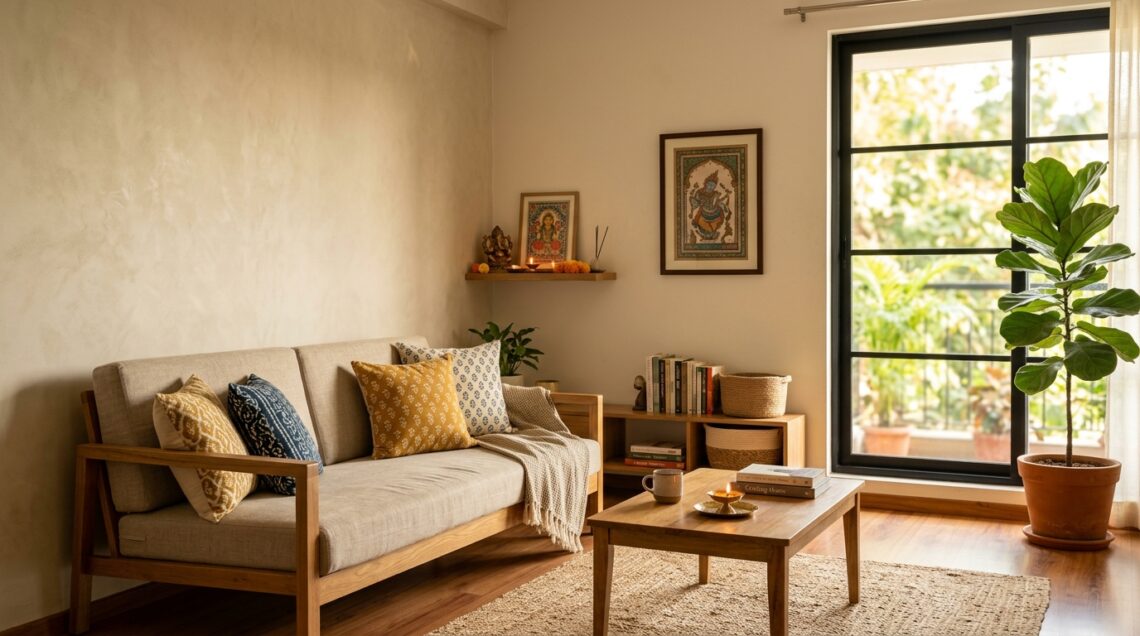
Minimalist Living in India: A Practical Guide 2026
Disclaimer: This article may contain affiliate links. If you purchase through these links, I may earn a small commission as an Amazon Associate—at no additional cost to you.
Quick Answer
Minimalist living in India means reducing clutter, buying intentionally, and creating calm spaces — adapted for the reality of Indian homes: joint families, festival seasons, puja rooms, and multi-use spaces. It does not mean giving up your culture, your thali sets, or your sarees. It means being intentional about what you keep and why.
The word minimalism often conjures images of stark white rooms with one chair and three items on a shelf. That version of minimalism is not only impractical for most Indian families — it is culturally irrelevant. A home with a puja room, a family of five, festival-season storage needs, and a kitchen that cooks for extended family on weekends is not going to become a Scandinavian design showroom. And it does not need to. Minimalism, properly understood, is not about owning fewer things. It is about owning the right things — those that serve a genuine purpose or bring genuine joy — and letting go of the rest. Applied to Indian homes, this approach creates calmer, more organised spaces that still feel warm, lived-in, and culturally rich.
Why Minimalism Is Particularly Relevant for Indian Homes Right Now
Indian homes — especially urban apartments — have become increasingly cluttered over the past two decades. Rising disposable incomes, the explosion of online shopping, and the habit of keeping things “just in case” or because they were gifts have filled homes with objects that no one uses. The average Indian 2BHK apartment has significantly more possessions per square metre than the same size apartment in most other countries. The mental and physical cost of this clutter is real: research consistently shows that visual clutter elevates cortisol (the stress hormone) and reduces the ability to focus. A more minimal home is genuinely a calmer, lower-stress home.
Minimalist Living Tips for Indian Homes
1. Start with One Drawer, Not the Whole House
The biggest barrier to decluttering is the overwhelming scale of it. Do not try to minimise your entire home in a weekend. Instead, choose one drawer, one shelf, or one area and give it thirty minutes. Remove everything, decide what to keep, donate, or discard, and put only the keepers back. The physical experience of that one clear space motivates the next session far more effectively than any planning does.
2. Apply the One-Year Rule to Possessions
For most household possessions — clothes, kitchen tools, decorative items, gadgets — if you have not used something in the past year, you are unlikely to use it in the next year. The one-year rule is a practical decision-making framework: if it has not been used or worn in twelve months, it goes into the donate or discard pile. The exceptions are genuinely seasonal items (festival decorations, wedding clothes), items with significant sentimental value, and emergency preparedness items.
3. Handle Gifted Items Thoughtfully
In Indian culture, refusing gifts is considered rude, and most Indian homes accumulate significant quantities of gifted items — decorative pieces, kitchen appliances, decorative crockery — that sit unused because the recipient did not choose them. The minimalist approach to gifted items: feel the gratitude for the gesture, use or display the item for a reasonable period, and then donate it if it truly does not serve your home. The value of a gift is in the giving, not in permanent possession.
4. Create a “One In, One Out” Rule for Purchases
Before buying any new item — a piece of clothing, a kitchen tool, a storage product — identify what existing item it will replace or supplement. If the answer is “nothing, I just want it,” that is useful information. The one-in-one-out rule does not prevent purchasing. It prevents accumulation by ensuring that new additions are genuinely replacing something or filling a genuine gap.
5. Minimise Surfaces, Not Storage
A common minimalism mistake is trying to clear out your entire storage system and living with nothing. A more practical Indian approach is to focus on surfaces: kitchen counters, side tables, dining tables, and dressing tables. Cleared surfaces make a room feel calm and spacious immediately, regardless of what is in the cabinets behind them. You can own as much as you need — just store it out of sight.
6. Curate Your Puja Room and Altar
The puja room or home altar is sacred space and not subject to minimalism in the same way as the rest of the home — its fullness is intentional and meaningful. However, many puja rooms accumulate duplicates, damaged items, and objects that are there out of inertia rather than devotion. A thoughtful review of puja items — keeping what is actively used and revered — creates a more focused, peaceful altar space without reducing its spiritual depth.
7. Buy Quality Over Quantity
One of the most consistent findings from people who embrace minimalism is that they spend the same amount of money but on fewer, better things. Rather than buying three inexpensive T-shirts that fade in a season, buying one well-made one that lasts years is both more economical long-term and generates less waste. This applies to kitchen tools, furniture, home textiles, and clothing equally.
8. Digitise What Can Be Digitised
Paper clutter is one of the most persistent sources of home disorder in Indian families — bills, school reports, medical records, bank statements, receipts. Digitising documents (a phone camera scan is sufficient for most purposes) and storing them on Google Drive or similar cloud storage eliminates the need for most physical paper storage. Keep originals only for legally required documents — property papers, official certificates, insurance documents.
9. Seasonal Rotation, Not Accumulation
Indian homes need seasonal items — monsoon raincoats, winter woolens, festival decorations, summer cooling fans. The minimalist approach is not to avoid having these things. It is to store them properly when not in season rather than leaving them as permanent clutter. Vacuum bags for seasonal textiles, labelled boxes for festival items, and a designated seasonal storage area (under the bed, top shelf, spare cupboard) contain seasonal accumulation without creating year-round mess.
10. Resist the New Year — Festival — Sale Cycle
Indian life has a beautiful rhythm of festivals and occasions — Diwali, Navratri, Holi, Eid, Christmas — and every festival comes with shopping pressure. The minimalist approach to festivals is not to avoid shopping, but to make deliberate choices: buy what you genuinely need or want for this specific occasion, and do not keep things just because they were bought. After every major festival, do a 30-minute review of new acquisitions and identify what can be donated or returned.
Minimalist Living Checklist for Indian Homes
- Start with one drawer or shelf — not the whole house
- Apply the one-year rule: if unused in 12 months, donate
- Clear surfaces in every room — keep cabinets but clear counters
- Create a one-in-one-out rule for new purchases
- Digitise paper documents that do not need physical originals
- Store seasonal items properly rather than leaving them as year-round clutter
- Curate the puja room thoughtfully — keep what is actively used
- Before buying, ask: what does this replace or what genuine gap does it fill?
Final Thoughts
Minimalism in an Indian context is not about becoming someone you are not, or creating a home that does not feel like yours. It is about deciding what genuinely belongs in your home and letting go of what does not. Every time you clear a surface, donate something unused, or decide not to buy something you do not need, you are making a small choice for a calmer, more intentional life. These small choices, made consistently, transform a home.
For more mindful living ideas, read our guides on morning rituals that bring calm to your day and meditation practices for busy Indian moms.
Frequently Asked Questions
Can you live minimally in an Indian joint family?
Yes, but it requires agreement and individual ownership of personal spaces. Start by decluttering your own wardrobe, your own belongings, and your own areas of the home. You cannot declutter others’ possessions without their agreement. Focus on shared spaces by clearing surfaces and improving organisation rather than reducing possession counts.
How do I declutter without my family noticing I donated things?
The most sustainable approach is transparency. Explain to family members what you are doing and why — that you want a calmer home with less to manage. Most family members are more receptive than expected once they experience the result of even one cleared space. Avoid secretly discarding shared items, as this creates conflict.
Is minimalism compatible with Indian culture and festivals?
Absolutely. Indian culture has a strong tradition of living simply alongside cultural richness — the philosophical concept of aparigraha (non-possessiveness) in both Hinduism and Jainism is essentially minimalist in spirit. Minimalism adapts to Indian life by keeping the culturally meaningful, the beautiful, and the practically useful while releasing the accumulated and the unnecessary.
How long does it take to create a minimalist home?
It is an ongoing process rather than a one-time event. Most people see meaningful results — calmer spaces, less daily stress — within 2 to 3 months of consistent small sessions. A full minimalist home review for an average Indian apartment takes 20 to 30 hours of cumulative effort spread over weekends.
What should I do with decluttered items in India?
Donate functional items to local NGOs, orphanages, and shelter homes — most will collect directly. Sell quality items on OLX, Facebook Marketplace, or Instagram reels. Textile waste can go to waste collection drives run by municipalities and NGOs. Books can be donated to local libraries, schools, or Little Free Library installations.
Can minimalism reduce household expenses?
Yes. Research from multiple countries, including India, shows that people who adopt minimalist principles typically spend less on impulse purchases, replace items less frequently due to buying higher quality, and spend less on storage solutions to manage their possessions. The reduction in spending is often 15 to 30 percent of discretionary household spending.
Where do I start with decluttering an Indian kitchen?
Start by identifying duplicates — how many steel dabbas, how many spatulas, how many pressure cookers? Indian kitchens often hold 3 to 5 of items that only one of is needed. Remove duplicates first, then tackle expired or unusable items, then address storage organisation. The kitchen shows the fastest visible results from decluttering.