How to Start a Tiffin Service Business in India
Disclaimer: This article may contain affiliate links. If you purchase through these links, I may earn a small commission as an Amazon Associate—at no additional cost to you.
Quick Answer
To start a tiffin service business in India, get FSSAI basic registration (₹100/year), identify your target customers (office workers, students, migrants), decide on a menu and pricing, invest ₹5,000 to ₹20,000 in tiffin containers and packaging, and market through WhatsApp and housing society groups. A tiffin service with 20 to 30 customers can generate ₹15,000 to ₹30,000 per month from a home kitchen.
The tiffin service is one of the oldest and most enduring home businesses in India. From the legendary dabbawalas of Mumbai to the thousands of home cooks serving offices, hostels, and housing societies across every Indian city, homemade tiffin meets a need that restaurants and food delivery apps do not: affordable, healthy, daily home food for people who cannot cook for themselves. In 2026, the combination of rising office return rates, migrant worker populations in cities, and growing preference for home-cooked over restaurant food makes the tiffin service an especially strong business opportunity. This guide walks you through every step of starting one.
Who Is Your Tiffin Customer?
Before thinking about menus or pricing, identify your target customer. The three most reliable tiffin customer groups in Indian cities and towns are: office workers (particularly in office parks, IT corridors, and commercial districts) who want a hot, home-cooked lunch delivered daily; students in hostels, paying guest (PG) accommodations, and college areas who want dinner and sometimes breakfast; and migrant workers and single working individuals who live alone and cannot cook. Each group has different menu preferences, timing needs, and price sensitivity. Identify which group your location is best positioned to serve.
Step-by-Step: How to Start a Tiffin Service
Step 1: Get Your FSSAI Basic Registration
The Food Safety and Standards Authority of India (FSSAI) requires all food businesses — including home kitchens selling food commercially — to register. The Basic Registration (for businesses with annual turnover under ₹12 lakh) costs ₹100 per year and can be completed online at the FoSCoS portal (foscos.fssai.gov.in). Registration typically takes 7 to 15 working days. Operating a food business without FSSAI registration is illegal and can result in fines. This step is non-negotiable.
Step 2: Plan Your Menu
Start simple. A reliable daily tiffin menu for North Indian customers typically includes: a dal or sabzi (vegetable preparation), two or three rotis, rice, and a pickle or chutney. For South Indian customers: rice, sambar or rasam, one vegetable preparation, curd, and papad. Keep your initial menu to 3 to 4 variations that rotate across the week. Complexity kills efficiency in a home tiffin operation — the goal is cooking 20 to 30 portions of the same meal efficiently, not elaborate restaurant cooking. A clear weekly menu also lets customers know what to expect and builds loyalty.
Step 3: Fix Your Pricing
Tiffin pricing in India ranges from ₹60 to ₹200 per tiffin depending on city, contents, and customer segment. Research the going rate in your area by checking local competitors on Zomato, Swiggy, and JustDial. For a home-cooked tiffin business starting out, pricing ₹80 to ₹150 per tiffin for a two or three-item meal is competitive in most Indian cities. Monthly subscriptions (30 meals for a fixed price) are the standard model — charge ₹1,800 to ₹3,500 per month per customer. Monthly pricing gives you predictable income and encourages customer commitment.
Step 4: Invest in Equipment and Containers
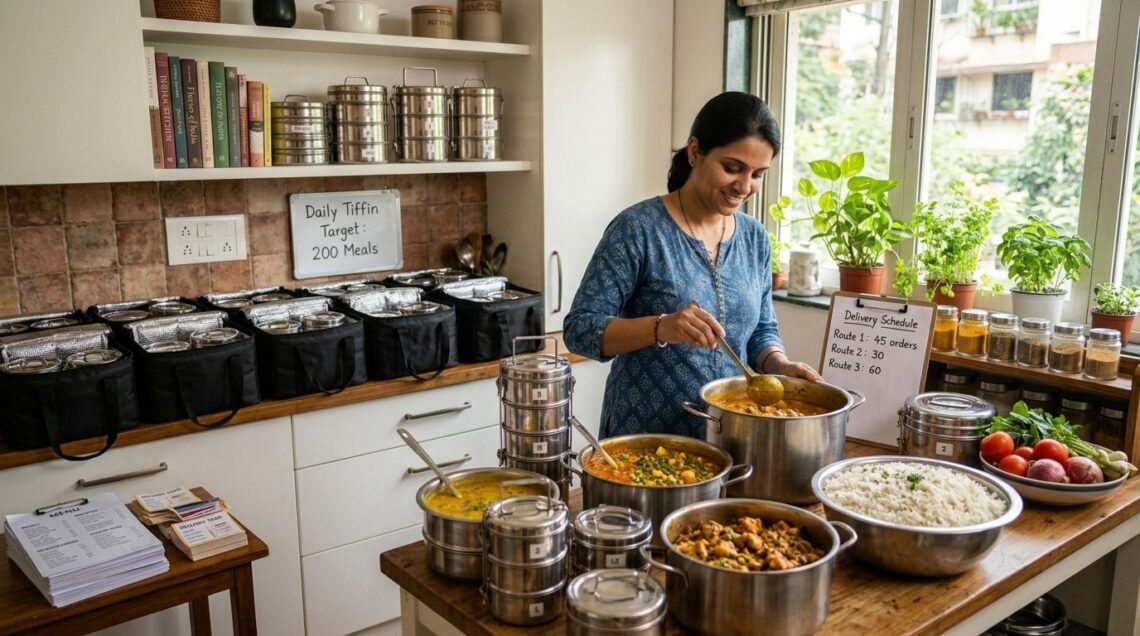
You do not need restaurant equipment. Your existing home kitchen is the production facility. What you do need: stainless steel tiffin boxes (the kind that seal without leaking) — budget ₹800 to ₹1,500 for 20 to 30 boxes; an insulated delivery bag to keep food hot during delivery — ₹500 to ₹1,500; and optionally, an extra pressure cooker or larger vessel if you are scaling beyond 10 customers quickly. Total starting investment in equipment: ₹3,000 to ₹5,000. Many operators start with just 5 to 10 customers using boxes they already own.
Step 5: Sort Delivery Logistics
Delivery is the most operationally challenging part of a tiffin service. Option 1: deliver yourself by bicycle or two-wheeler to a defined delivery radius (1 to 3 km from your home). Option 2: hire a part-time delivery person — typically ₹4,000 to ₹8,000 per month in Indian cities. Option 3: arrange customer pick-up from your home, which many successful operators in residential societies use to eliminate delivery costs entirely. Keep your delivery radius tight, especially in the beginning — attempting to serve customers 5 km away with home delivery is not sustainable without dedicated delivery staff.
Step 6: Market Your Service
The most effective marketing channels for a new tiffin service in India, in order of effectiveness: WhatsApp — share your menu image and contact number in housing society groups, neighbourhood groups, office groups, and college groups. This is how most tiffin services in India find their first 10 customers. Local Facebook and Instagram groups for your area. A listing on JustDial (free) and Swiggy/Zomato (for delivery apps, which take a commission of 15 to 30 percent — useful for visibility but reduce margins). Physical flyers in housing society noticeboards, office canteens, and hostel common areas. Ask your first 5 customers for WhatsApp referrals — word of mouth is the most effective growth channel for tiffin services.
Step 7: Set Up Payments
Accept UPI payments from day one — Google Pay, PhonePe, or Paytm. Most Indian customers prefer UPI for recurring payments. Set up a monthly advance payment system: customers pay for the month at the beginning of the month. This eliminates the daily cash collection problem and gives you capital to purchase ingredients in advance. Share a QR code with each customer.
Tiffin Service Business: Expected Costs and Income
Starting investment: ₹5,000 to ₹20,000 total (equipment, initial marketing, FSSAI registration).
Monthly operating costs (for 20 customers): ingredients ₹8,000 to ₹15,000, gas ₹500 to ₹1,000, packaging ₹500 to ₹1,000, delivery costs ₹0 to ₹6,000.
Monthly income (20 customers at ₹1,500 per month): ₹30,000. Monthly income (30 customers at ₹2,000 per month): ₹60,000.
Typical net profit margin for a home tiffin service: 35 to 55 percent, depending on food costs, delivery arrangements, and pricing.
Checklist: Before You Take Your First Customer
- FSSAI Basic Registration completed
- Menu planned for at least 2 weeks of daily variation
- Pricing decided and monthly subscription amount fixed
- Tiffin containers purchased — at least 10 to 20
- Delivery radius defined and delivery method confirmed
- UPI payment QR code set up
- WhatsApp marketing message and menu image prepared
- Kitchen cleaned and organised for larger-volume cooking
Final Thoughts
The tiffin service is one of the most dignified, skill-based home businesses available to Indian women with a talent for cooking. It generates real income, uses an existing skill, requires minimal investment, and provides a genuinely valuable service to people who depend on it daily. If you cook well and you live near offices, hostels, or housing societies, you already have a business. The steps above will help you build it properly.
For more home-based business ideas for Indian women, read our guide on village business ideas for women in India.
Frequently Asked Questions
How much money do I need to start a tiffin service in India?
You can start a tiffin service for as little as ₹5,000 to ₹15,000. The main costs are tiffin containers, an insulated delivery bag, and FSSAI registration. Your existing home kitchen is the production facility. Many successful tiffin businesses started with ₹3,000 and 5 initial customers.
Do I need FSSAI registration for a home tiffin service?
Yes. Any food business selling food commercially — including a home tiffin service — requires at minimum FSSAI Basic Registration. The basic registration costs ₹100 per year and is completed online at the FoSCoS portal. It is legally required and protects you from penalties.
How many customers do I need to make a tiffin service profitable?
Most home tiffin operators say 15 to 20 monthly customers is the breakeven point where the business becomes meaningfully profitable. At 20 customers paying ₹1,500 per month, monthly income is ₹30,000 before costs. At 30 customers, income rises to ₹45,000 or more depending on pricing.
Should I list my tiffin service on Swiggy or Zomato?
It is worth trying once you have an established base of 15 to 20 direct customers and a consistent cooking routine. Swiggy and Zomato charge 15 to 30 percent commission, which significantly reduces margins. Use these platforms for new customer discovery but try to convert app customers to direct WhatsApp customers over time to protect your margins.
How do I retain tiffin customers long-term?
Consistency is the most important factor — same quality and quantity every day. Offer a variety rotation so customers do not eat the same thing more than once a week. Respond quickly to complaints. Offer a one-day break if a customer is travelling. Small personal touches — a festival special thali, a Diwali gift — build genuine loyalty. The best tiffin operators in India have customers who stay for 2 to 5 years.
What is the best menu for a tiffin service in India?
The best menu matches the preferences of your target customer group. For a North Indian audience: dal, sabzi, roti, rice, and pickle is the standard. For South Indian: rice, sambar/rasam, vegetable preparation, curd, and papad. Research your local area. The most important thing is that your food tastes like genuine home cooking — that is what tiffin customers specifically seek and what restaurants cannot replicate.
Can I run a tiffin service from a small kitchen?
Yes. Most successful home tiffin services run from standard Indian home kitchens. Cooking 20 to 25 portions of a meal that you would normally make for 4 to 6 people requires modest scaling, not a large kitchen. Organisation is the key — read our guide on kitchen organiser items to set up your kitchen for efficient high-volume cooking.