
Disclaimer: This article may contain affiliate links. If you purchase through these links, I may earn a small commission as an Amazon Associate—at no additional cost to you.
Family life in an Indian home rarely runs to a timetable. Office hours stretch, tuition runs late, a grandparent needs the bathroom at the same time as the school bus, and the living room doubles as a playroom, a study and a guest room. None of that is going to change. What can change is how the home is set up and how the day is shaped around it.
This guide brings together everything HomeSoul covers on family life at home: daily routines, kids’ spaces in small flats, chores by age, screen time, and festival and holiday activities. It is written for parents in ordinary 1 to 3 BHK homes, often rented, sometimes shared with grandparents. Start with whichever section is causing you the most trouble this week.
What makes family life at home easier
Families who seem calm at home usually have three things in place, and none of them cost much.
- A few fixed points in the day. Not a strict schedule, just two or three moments everyone can count on: the morning rush, dinner and bedtime.
- A place for everything children use. When toys, books, uniforms and school bags each have a home, half the daily arguments disappear.
- Shared work. When children have real jobs, the home stops being one person’s responsibility.
The sections below take each of these in turn, then cover festivals, holidays and family time.
Daily routines
School mornings
Most morning chaos starts the night before. Pack school bags, lay out uniforms and fill water bottles before bed, and keep the tiffin menu for the week on the fridge so nobody decides at 6:30 am. Give each child a simple picture or word list of their morning steps (brush, dress, breakfast, shoes, bag) and stick it at their eye level. Wake up 15 minutes before the children, so you are ready before the questions start.
Our guide to morning rituals that bring calm to your day has ideas for those first 15 minutes for yourself.
Dinner together
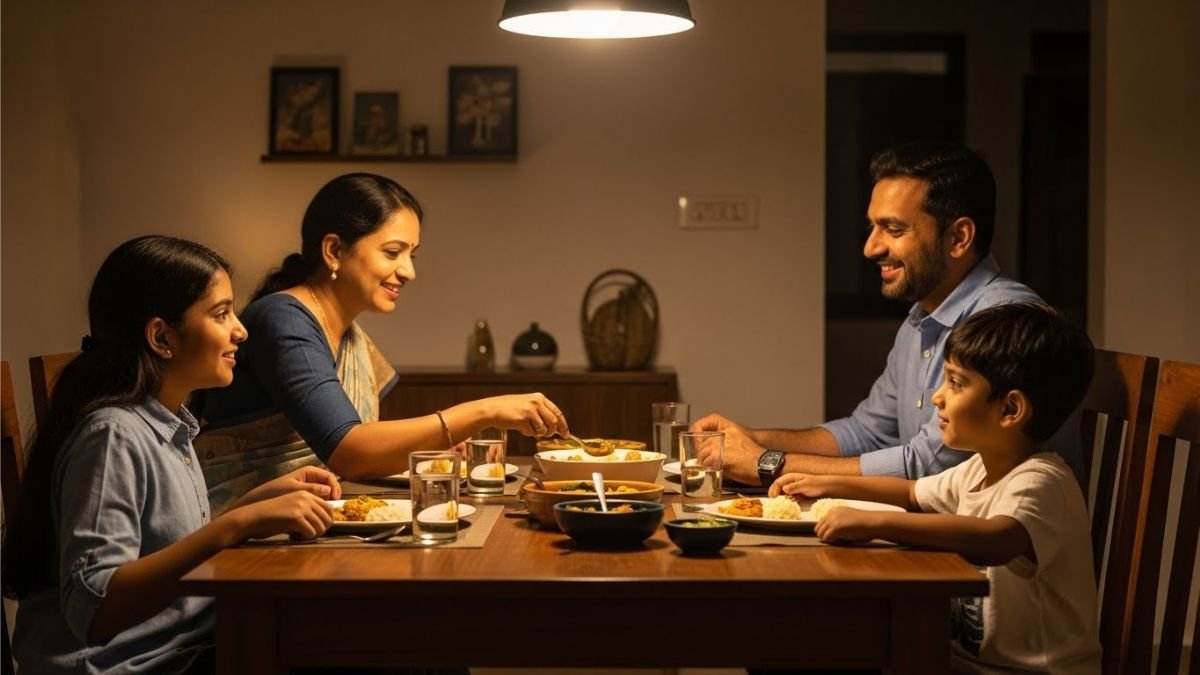
For many families, dinner is the only time everyone is in one place. A dinner window works better than a fixed time: whoever is home between, say, 8:00 and 8:45 eats together. Keep phones in a basket, give every child a job, and keep weekday meals simple. Our full guide to creating a happy family dinner routine covers jobs by age and seating in a joint family.
Screen time: a family media plan
Screens are now the biggest source of daily friction in many homes. The Indian Academy of Pediatrics recommends no screen exposure for children under 2, a maximum of one hour of supervised screen time a day for children aged 2 to 5, and less than two hours a day for children aged 5 to 10 (Indian Pediatrics, 2022).
Rules work better when they are about places and times rather than constant counting:
- Screen-free places: the dining table and bedrooms.
- Screen-free times: the first hour after waking, meals, and the hour before bed.
- A charging spot: all phones and tablets charge overnight in one place outside the bedrooms, adults’ included.
- Write it down: agree the rules as a family and stick them on the fridge, so you are not renegotiating every evening.
Bedtime
A predictable bedtime routine helps children wind down, especially in homes where siblings share a room. Keep the same order every night: bath or wash, night clothes, a story or a chat, lights out. In a shared room, put the younger child to bed first and let the older one read with a small lamp for 15 minutes. Dim the main lights and switch off the TV in the room next door half an hour before bedtime.
A Sunday reset
Fifteen minutes of daily tidying keeps a family home under control, and a short weekly reset catches the rest. On Sunday evening, everyone puts their things back in their place, school bags are repacked, uniforms are checked and the week’s tiffin menu goes up. Our 15-minute daily cleaning routine shows how to keep the weekdays manageable.
Kids’ spaces in an Indian flat
A room of their own, even on rent
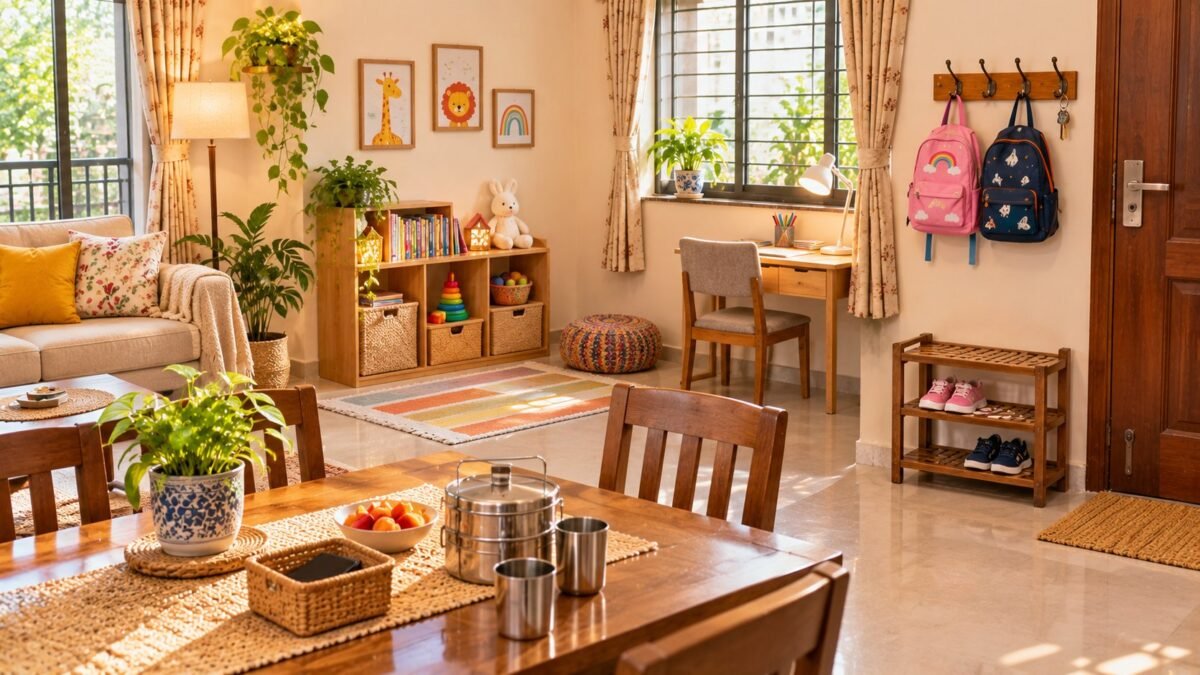
Most Indian children share a room with a sibling or a grandparent, or have a corner rather than a room. That is enough, as long as the corner is clearly theirs. Mark it with a rug, a low shelf and a few hooks at their height. In a rented flat, use freestanding shelves, adhesive hooks and over-the-door organisers instead of drilling, and choose furniture you can take with you when you move.
Toy storage
The trick with toys is fewer at a time, not more storage. Keep a third of the toys out and the rest in labelled boxes under the bed, and swap them every few weeks so old toys feel new. Use open baskets that a child can tidy in one move, with a picture label on the front. Our guide to under-bed storage ideas for Indian bedrooms covers boxes that fit standard bed heights.
A study table that works
A study table needs good light, a chair at the right height and nothing on it that is not for studying. Place it near a window or add a desk lamp on the side opposite the writing hand. Keep a small tray for pens and a wall shelf or file holder for the current term’s books, and move last year’s books out. A child should be able to sit with feet flat on the floor or on a footrest.
A school bag station
Choose one spot near the door for everything that leaves the house each morning: a hook for each school bag, a small shelf or basket for shoes and socks, and a tray for notes that need signing. It takes ten minutes to set up and saves the daily search for the missing tie or ID card.
Baby-proofing a small flat
With a crawling baby, small flats need a quick safety check: socket covers on low plugs, cupboard locks on the kitchen and bathroom cabinets where cleaners are kept, corner guards on low tables, and heavy furniture such as bookshelves and TV units fixed to the wall. Keep floor-level balcony doors locked and never leave a bucket of water on the floor. Your paediatrician can advise on anything specific to your child.
For the bigger picture on keeping everyone’s things in order, see our guides to organising clothes in your closet and saree storage ideas for your wardrobe.
Chores and life skills
Children who help at home learn skills school does not teach, and the home stops depending on one person. Start with jobs they can finish without help, and add harder ones as they grow. These are rough guides; every child is different.
| Age | Chores they can usually manage |
|---|---|
| 3 to 5 years | Put toys in baskets, put dirty clothes in the laundry bag, carry their own plate, water a plant |
| 6 to 9 years | Make their bed, set and clear the table, fold small clothes, pack their own school bag, feed a pet |
| 10 to 12 years | Sweep a room, fold and put away laundry, help with simple cooking, take out the rubbish |
| 13 and up | Cook a simple dish, iron their uniform, clean the bathroom sink, do a grocery run with a list |
A chores chart on the fridge works better than reminders. Rotate the jobs weekly so nobody is stuck with the same one, and praise the effort, not the result.
Kids in the kitchen
The kitchen is where children pick up the most useful skills. Young children can wash vegetables, tear coriander and knead a small ball of atta. Older children can measure ingredients, make a salad or raita, and eventually cook a full dal-chawal. Keep them away from hot oil and the pressure cooker until they are old enough to handle both safely with you watching. A well-organised kitchen helps; see our list of kitchen organiser items for Indian kitchens.
Festivals, holidays and family time
Festivals and school holidays are when family time at home matters most, and when the house is busiest. A little planning turns them from stressful into something children remember.
| When | What to plan at home |
|---|---|
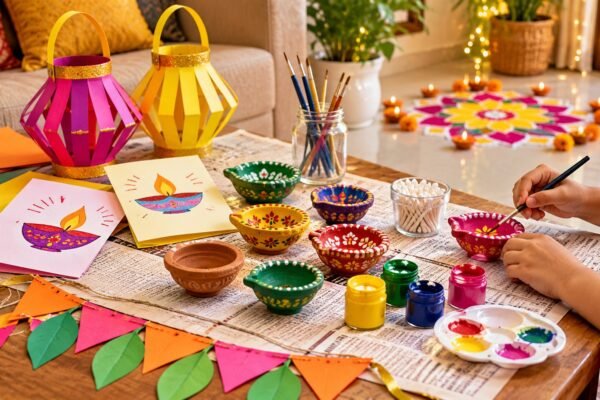
| Diwali (October or November) | Cleaning jobs by age, diya painting, rangoli, stories behind the festival, safe fun on smoky nights |
| Winter break (December) | Indoor projects, board-game evenings, a family cooking day, sorting old clothes and toys for donation |
| Holi (February or March) | Homemade natural colours, oiling skin and hair beforehand, an easy clean-up plan |
| Summer holidays (April to June) | A loose weekly plan, a project for each child, cooking lessons, time with grandparents |
| Birthdays | Simple home parties, plastic-free decorations, useful return gifts |
For this Diwali, see our ideas for Diwali activities for kids at home. For eco-friendly ideas that suit festivals and birthdays alike, see our natural and organic gift ideas.
Time with teenagers
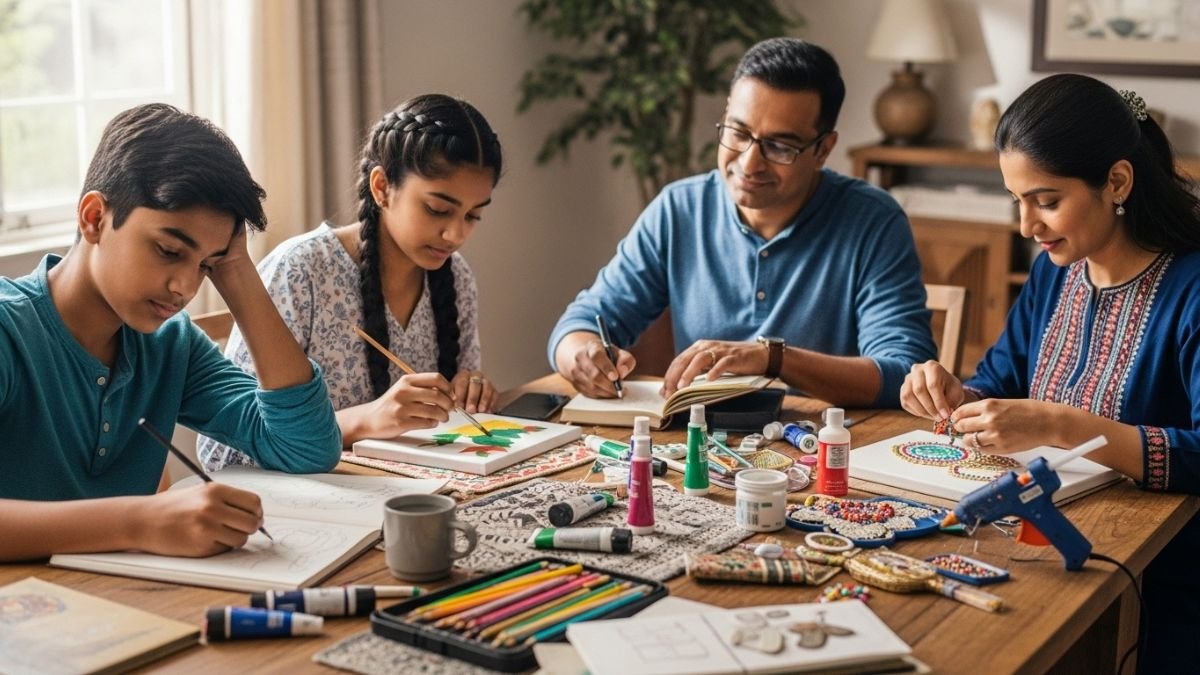
Teenagers want independence but still need family time. Short, regular activities they choose work better than long planned outings: a regional thali cooked together, a quiz night, an evening walk, recording a grandparent’s stories. Our list of 20 family activities to do at home with teens has ideas that suit an ordinary flat.
Living with grandparents
Many Indian families share a home with grandparents, which brings extra hands and extra adjustments. A few things make daily life smoother for everyone:
- Agree the main rules together. Screen time, sweets and bedtimes go more smoothly when parents and grandparents give children the same answer.
- Give grandparents a role they enjoy. Storytelling at bedtime, a cooking lesson, help with homework in a subject they know.
- Keep the routines gentle. Grandparents often eat and sleep earlier. Plan a few nights a week when everyone eats together at one time.
- Make the home safe for them too. Night lights in the passage, a non-slip mat in the bathroom and no clutter on the floor help older family members as much as toddlers.
Start this week: a seven-day plan
You do not need to change everything at once. Try one small step a day:
- Day 1: Set a dinner window and tell the family.
- Day 2: Put a phone basket near the dining table.
- Day 3: Set up a school bag station near the door.
- Day 4: Pack bags and lay out uniforms the night before.
- Day 5: Give each child one chore from the table above.
- Day 6: Put away a third of the toys in a box under the bed.
- Day 7: Do a 15-minute Sunday reset as a family, and plan next week’s tiffins.
Frequently asked questions
How do I create a daily routine for my family?
Start with three fixed points: mornings, dinner and bedtime. Make each one predictable, then add small habits around them, such as packing bags at night or a phone basket at dinner. Keep the rest of the day flexible.
How much screen time is right for children?
The Indian Academy of Pediatrics recommends no screens for children under 2, up to one hour of supervised screen time a day for ages 2 to 5, and less than two hours a day for ages 5 to 10. Screen-free meals and bedrooms make these limits easier to keep.
What chores can a 5-year-old do?
Putting toys in baskets, carrying their own plate to the kitchen, putting dirty clothes in the laundry bag and watering a plant. Keep it to one or two jobs they can finish on their own.
How do I organise a kids’ room in a small rented flat?
Give the child a clearly marked corner, use freestanding shelves and adhesive hooks instead of drilling, keep only a third of the toys out at a time, and store the rest in labelled boxes under the bed.
How can grandparents and parents agree on rules for children?
Sit down together and agree the main rules, such as screen time, sweets and bedtime, before discussing them with the children. Children follow rules more easily when every adult in the home gives the same answer.
Sources
- Indian Academy of Pediatrics, Guidelines on Screen Time and Digital Wellness in Infants, Children and Adolescents, Indian Pediatrics 59(3), March 2022