How to Organize Clothes in Closet by Category: Complete System Guide
Disclaimer: This article may contain affiliate links. If you purchase through these links, I may earn a small commission as an Amazon Associate—at no additional cost to you.
Category-based organization is the most sustainable closet system because it mirrors how you naturally think when getting dressed. When you wake up thinking “I need a formal shirt,” you know exactly where to look instead of searching through mixed piles.
Professional organizers report that category-based systems reduce morning dressing time by 60-70%. You eliminate decision fatigue because similar items are grouped together, making outfit coordination effortless. This system also reveals duplicate purchases—when you see five black kurtas hanging together, you’ll think twice before buying another.
The beauty of this method lies in its flexibility. Unlike color-coding or seasonal organization, categories adapt to your lifestyle. A working professional can create detailed office wear categories, while someone working from home might need extensive casual and ethnic wear sections.
Primary Categories for Indian Wardrobes
Every closet organization system starts with identifying your primary categories. For most Indian households, these include:
- Tops – Shirts, blouses, kurtis, t-shirts, tunics
- Bottoms – Jeans, trousers, palazzos, leggings, skirts
- Ethnic Wear – Sarees, salwar suits, anarkalis, lehengas
- Western Formal – Blazers, office shirts, work dresses
- Occasion Wear – Party outfits, wedding clothes, festive attire
- Seasonal & Athleisure – Winter wear, activewear, sleepwear, loungewear
These six categories form the foundation. Customize based on your lifestyle—someone who works out daily needs a larger athleisure section, while someone attending frequent events needs expanded occasion wear storage.
Step-by-Step Category Organization Process
Step 1: Complete Wardrobe Audit
Empty your entire closet and create a staging area on your bed or floor. This seems overwhelming, but seeing everything together is essential for accurate categorization.
As you remove items, make three piles:
- Keep: Items you’ve worn in the last year and still love
- Donate/Sell: Good condition but no longer fits your lifestyle
- Discard: Damaged, stained, or beyond repair
Indian wardrobes often accumulate emotional purchases—wedding gifts, expensive items worn once, clothes from your pre-pregnancy size. Be honest about what serves your current life. Studies show we wear only 20% of our wardrobe 80% of the time.
Step 2: Create Your Personal Category System
Not every wardrobe needs all categories. Design your system based on:
Lifestyle analysis
- Work from home? Expand casual and lounge wear
- Corporate job? Prioritize formal and office-appropriate categories
- Frequent traveler? Create a “travel favorites” category
- Stay-at-home parent? Focus on comfortable, practical daily wear
Space availability
- Small closets: Limit to 4-5 broad categories
- Medium closets: 6-7 detailed categories
- Large walk-ins: 8-10 categories with sub-divisions
Write down your final categories and the percentage of closet space each deserves. This planning prevents arbitrary organization that doesn’t match your actual usage patterns.
Step 3: Assign Physical Zones in Your Closet
Map your closet space to categories using accessibility logic:
- Eye-level zone (most accessible): Assign to your most frequently worn category—office wear for professionals, daily ethnic wear for homemakers.
- Upper shelves: Seasonal items, occasion wear, and rarely used categories. Use labeled storage boxes for quick identification.
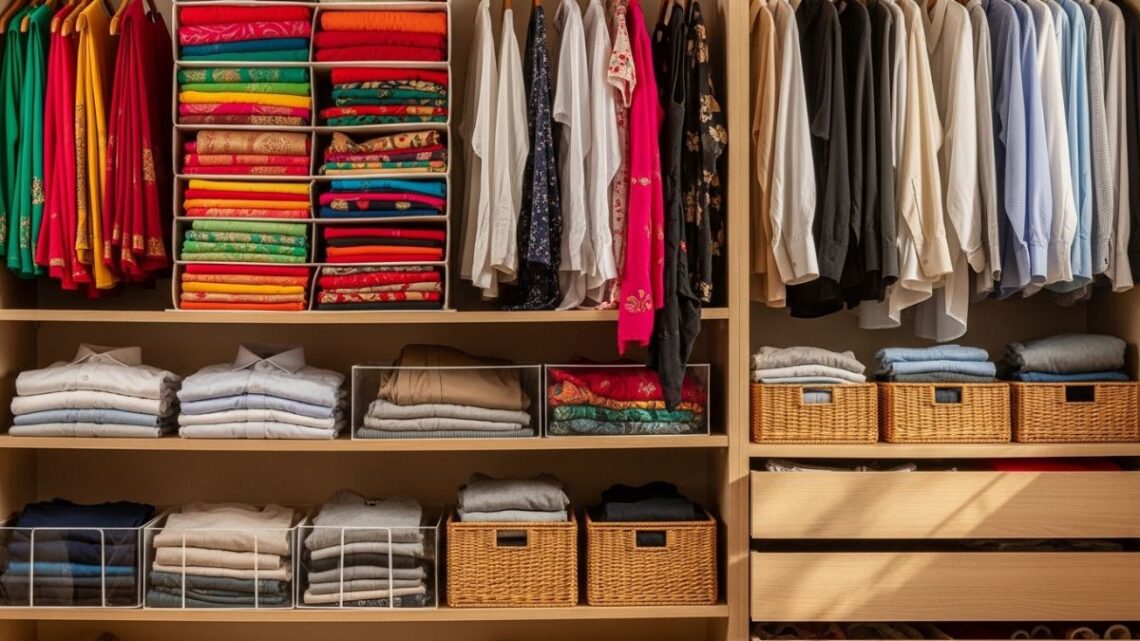
- Middle hanging section: Primary categories that need wrinkle-free storage. Allocate rod space proportionally—if 40% of your outfits are kurtis, give them 40% of hanging space.
- Lower shelves/drawers: Folded bottoms, athleisure, and heavy items. The bottom area handles weight better and suits items that don’t wrinkle easily.
Create physical boundaries for each category using shelf dividers, separate hangers, or colored stickers on rods to mark where one category ends and another begins.
Step 4: Organize Within Each Category
After assigning zones, organize items within each category using secondary sorting:
- Method A: By Formality LevelArrange from casual to formal: Casual everyday → Smart casual → Semi-formal → Formal
- Method B: By Color GradientOrganize in rainbow order: White → Beige → Yellow → Orange → Red → Pink → Purple → Blue → Green → Brown → Grey → Black
- Method C: By Frequency of UsePlace most-worn items at the front, occasionally worn items further back: Weekly rotation at front → Monthly wear in middle → Rarely worn at back
- Method D: By Outfit SetsKeep complete outfits together: Sarees with matching blouses, salwar suits as complete sets, blazers with matching trousers
Choose one secondary sorting method and apply it consistently across all categories. Mixing methods creates confusion.
Detailed Category-Specific Organization Strategies
Organizing Tops (Shirts, Kurtis, Blouses)
- Hanging vs. Folding Decision:
- Hang: Delicate fabrics (silk, chiffon), formal shirts, structured blouses
- Fold: Cotton t-shirts, casual wear, knitwear (hanging stretches them)
Use slim velvet hangers instead of plastic—they save 30% rod space and prevent slipping. Hang tops facing the same direction for uniform appearance.
- Kurti organization specifics: Separate by length—short kurtis, medium kurtis, long kurtis, and anarkali-style kurtis separately. Within each length category, organize by fabric weight (light to heavy) or color.
- Blouse organization for saree wearers: Store blouses with their matching sarees, not separately. Use saree bags with pockets designed to hold the blouse and fall/petticoat together.
Organizing Bottoms (Jeans, Trousers, Palazzos)
- Jeans and trousers: Hang by the hem using clip hangers to save horizontal space. This method fits 2-3 times more bottoms than traditional waistband hanging.
- Palazzos and loose pants: These wrinkle easily and need hanging. Use pant hangers with soft clips that don’t leave marks.
- Leggings and jeggings: Perfect for folding. Use the file-folding method (fold vertically and stand upright in drawers) so you can see every pair without unstacking. Organize by color in rainbow order.
Organizing Ethnic Wear (Sarees, Suits, Traditional)
Saree organization
Option 1 – Hanging system (best for regular rotation): Use specialized saree hangers that hold 5-10 sarees each. Organize by fabric type:
- Cotton and handloom sarees
- Silk sarees
- Georgette and chiffon
- Heavy work and wedding sarees
Option 2 – Shelf storage (for large collections): Use breathable cotton saree bags or fold sarees individually with muslin cloth between layers. Stack horizontally and label shelf edges.
Never use plastic covers for long-term saree storage—they trap moisture and cause yellowing.
Salwar suit organization
Keep three-piece sets together always:
- Hang the kameez, fold the salwar and dupatta, and clip them to the same hanger
- Hang the kameez, store matching salwar and dupatta in a labeled drawer beneath
- Fold all three pieces together, wrap in muslin, and stack on shelves
Lehenga and heavy ethnic wear
Hang on padded hangers with enough space between pieces. Cover with breathable cotton covers. Store the dupatta and blouse in a separate box labeled with the lehenga color/occasion.
Organizing Western Formal & Office Wear
- Blazers and jackets: Always hang on wooden or padded hangers that support shoulder structure. Organize by color or formality level.
- Formal shirts and blouses: Hang all formal tops to prevent wrinkles. Group by color within the formality level.
- Complete outfit organization: Consider creating a “5-day work section” where you pre-plan Monday-Friday outfits. This saves 15-20 minutes every morning.
Organizing Seasonal & Occasion Wear
- Seasonal rotation system: During summer, move heavy winter wear to upper shelves or under-bed storage. During winter, bring them to eye-level access and move summer items up. Use vacuum bags for extreme seasonal storage—they compress heavy sweaters and shawls to 75% less space.
- Occasion wear management: Create a “special occasion” section for wedding wear, party outfits, and festive clothes. Organize by event type:
- Wedding and ceremony outfits
- Festival and puja clothes
- Party and cocktail wear
Labeling System for Long-Term Maintenance
Labels are the secret to maintaining category organization, especially in shared closets.
What to Label
- Shelves and sections: Use label makers or printed labels indicating category names: “Formal Tops,” “Ethnic – Suits,” “Casual Bottoms.”
- Storage boxes and bins: Every closed container needs external labels with category and sub-category: “Sarees – Silk – Blue/Green.”
- Drawer dividers: Label each divided section to help family members maintain the system.
Label Options
- Budget-friendly: Masking tape with permanent marker, printed labels on paper
- Premium options: Label maker with clear tape, chalkboard labels (erasable), custom printed adhesive labels
- Indian language consideration: Create bilingual labels (English + Hindi/Tamil/Telugu) if sharing the closet with family members who prefer regional languages.
Common Category Organization Mistakes to Avoid
- Creating too many micro-categories: Having 15+ tiny categories creates confusion. Stick to 5-8 main categories with 2-3 sub-categories each maximum.
- Mixing category types: Don’t organize tops by color but bottoms by occasion. Choose one primary principle (category) and one secondary principle (color/formality) and apply consistently.
- Ignoring your actual lifestyle: Creating an elaborate “office wear” category when you work from home is pointless. Design categories around how you actually live.
- Not adjusting for life changes: New job? Revise your formal wear section. Had a baby? Expand comfortable daily wear. Review and modify your system annually.
Final Category Organization Checklist
- All clothes sorted into main categories (tops, bottoms, ethnic, formal)
- Each category has a dedicated physical zone in the closet
- Items within categories organized by secondary method (color/formality/frequency)
- All storage boxes and shelves labeled clearly
- Frequently worn categories placed at eye level
- Seasonal items moved to upper shelves or storage
- Complete ethnic outfits kept together
- Hanging vs. folding decision made per category
- Family members understand the category system
- Weekly maintenance routine scheduled
Category-based closet organization transforms your daily routine from stressful searching to effortless selection. Start with just one category this week—perhaps your most-worn section—perfect it completely, then move to the next. Within a month, you’ll have a fully categorized closet that maintains itself with minimal effort and saves you valuable time every single morning.
Frequently Asked Questions
Organize by category first (tops, bottoms, ethnic wear), then arrange by color within each category. This matches how you naturally think when getting dressed—”I need a formal shirt” rather than “I need something blue”—making the system more sustainable long-term.
Most Indian wardrobes work best with 5-8 main categories. Small closets need 4-5 broad categories, while larger wardrobes can handle 7-10 detailed ones. If you hesitate about where an item belongs, you have too many divisions.
Place your most frequently worn category at eye level in the most accessible closet area—typically the middle hanging section or front shelf. Put your weekly rotation items at the very front for fastest morning access.
Use specialized saree hangers or fold with muslin cloth between layers (never plastic). For salwar suits, hang the kameez and store the salwar-dupatta in a breathable bag attached to the same hanger. Heavy lehengas need padded hangers with cotton garment covers.