
Disclaimer: This article may contain affiliate links. If you purchase through these links, I may earn a small commission as an Amazon Associate—at no additional cost to you.
Diwali falls at the start of the season when air quality in many Indian cities is already poor, and crackers add a sharp spike on top. In Delhi, the Centre for Science and Environment found PM2.5 peaked at 603 micrograms per cubic metre around midnight on Diwali night in 2024, about ten times the 24-hour safe standard, before easing to under 100 by noon the next day (Down To Earth).
You cannot control the air outside. You can do quite a lot about the air inside your home. These are practical home steps; if anyone in your family has asthma or a heart or lung condition, talk to their doctor about a plan for the festival.
Check the air quality index first
India’s National Air Quality Index groups readings into six categories (Indian Economic Service, Arthapedia):
| AQI | Category | What it means |
|---|---|---|
| 0 to 50 | Good | Minimal impact |
| 51 to 100 | Satisfactory | Minor breathing discomfort for sensitive people |
| 101 to 200 | Moderate | Discomfort for people with asthma, heart disease, children and older adults |
| 201 to 300 | Poor | Breathing discomfort for most people on prolonged exposure |
| 301 to 400 | Very poor | Respiratory illness possible on prolonged exposure |
| 401 to 500 | Severe | Affects healthy people; serious for those with existing illness |
You can check your city’s live reading on the Central Pollution Control Board’s Sameer app (Nicobar Times). Checking it in the evening and again the next morning tells you when to open up the house.
Time when you open the windows
Fresh air matters, but opening windows during the worst hours brings the smoke straight in.
- Close windows and balcony doors in the evening once crackers start, and keep them closed through the night.
- Air the house the next day once the reading has come down, usually late morning or afternoon after Diwali night.
- Open windows on opposite sides of the house for a short burst of cross-ventilation rather than leaving one window open all day.
If children are indoors for the evening with the windows shut, our Diwali activities for kids has quiet ideas to keep them busy.
Clean without stirring up dust
Sweeping and dry dusting push fine particles back into the air. The World Health Organization recommends wet mopping and damp dusting over sweeping, or vacuuming only with a HEPA-filter vacuum (WHO).
In the days around Diwali:
- Mop floors with a damp mop instead of a dry jhadu.
- Wipe windowsills and ledges with a damp cloth, where cracker ash settles.
- Wash cushion covers and curtains after the festival rather than shaking them out.
Our post-Diwali cleaning guide covers cracker residue, wax and diya oil in more detail.
Keep indoor smoke low
On days when the air outside is bad, smoke from inside the home adds to it. WHO advises avoiding candles and incense when pollution is high (WHO).
That does not mean skipping the puja. A few practical steps:
- Light only the diyas and dhoop the puja needs, and put them out afterwards.
- Light incense for a short time rather than keeping it burning all evening.
- Run the kitchen chimney or exhaust fan while frying festive snacks, and for a few minutes after. Clean filters work better; our kitchen deep cleaning guide shows how to clean them.
- Keep crackers well away from the house, and do not burst any indoors or on a closed balcony.
Should you use an air purifier?
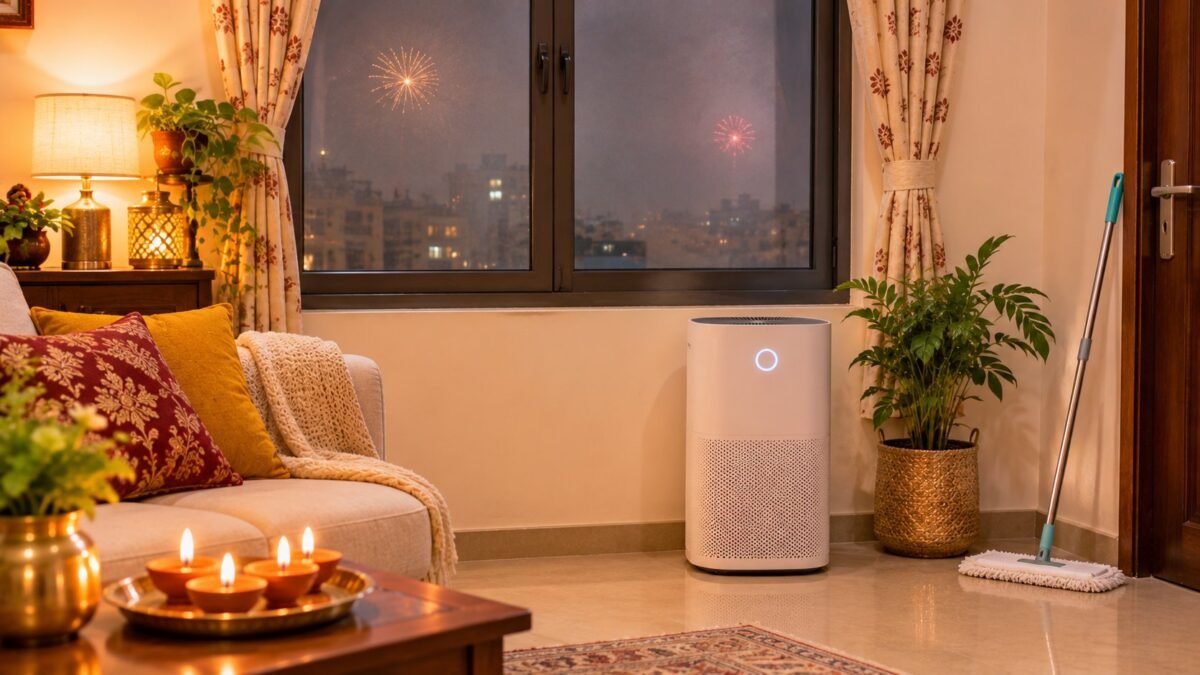
An air purifier with a true HEPA filter can reduce fine particles in a closed room. King County Public Health in the US gives a simple sizing rule: a clean air delivery rate (CADR) of about 65 for every 100 square feet of room (King County). For a 150 sq ft bedroom, that means a CADR of roughly 100 or more.
The same guidance suggests:
- Choose a unit rated a little higher than the room needs, so it can run on a quieter setting.
- Avoid extra features such as ionisers or ozone generators unless they are independently certified.
- Keep doors and windows closed while it runs, and leave it on; it does nothing when switched off.
- Put it in the room where people spend the most time, usually the bedroom at night.
- Check and replace the filter as the manual says.
If you do not have a purifier, keeping one room closed and cleaned with damp cloths gives the family a better space to sleep on the worst nights.
What houseplants can and cannot do
Plants make a home feel fresher, and they are good gifts. They do not clean polluted air in any meaningful way. A 2019 review by Drexel University researchers found that it would take around five plants per square metre to match the air exchange that ordinary ventilation provides, far more than any home could hold (ScienceAlert). Keep your plants for the joy of them, and rely on closed windows, wet cleaning and filtration for the air.
A simple plan for Diwali week
| When | What to do |
|---|---|
| Before Diwali | Clean filters in the chimney and any purifier; switch to damp mopping |
| Diwali evening | Close windows once crackers start; keep puja smoke short; run the purifier |
| Diwali night | Keep one room closed for sleeping |
| Next day | Check the AQI; air the house once it falls; damp-wipe sills and ledges |
For everything else in the run-up to the festival, see our Diwali preparation checklist, and for ways to cut smoke and waste from the celebration itself, our eco-friendly Diwali ideas.
Frequently asked questions
How can I reduce pollution inside my home during Diwali?
Keep windows closed in the evening and at night when crackers are burst, damp-mop instead of sweeping, keep incense and dhoop to a minimum, and run a HEPA air purifier in the room where you sleep.
When should I open windows after Diwali?
Check the AQI on the Sameer app and open windows once the reading has fallen, usually late morning or afternoon the next day.
Do air-purifying plants work?
Not in any meaningful way. Research shows houseplants remove very little from indoor air compared with ventilation or a filter.
What size air purifier do I need?
A common rule is a CADR of about 65 for every 100 square feet of room, with some extra headroom so it can run quietly.
Sources
- Down To Earth, Post-Diwali 2024 analysis by CSE
- Indian Economic Service, Arthapedia, National Air Quality Index
- Nicobar Times, Real-time air quality data on CPCB portal and Sameer app
- World Health Organization, Preventing the harmful effects of air pollution
- King County Public Health, HEPA air cleaners
- ScienceAlert, Potted plants are not making the air any cleaner