Front Load vs Top Load Washing Machine: Which Is Right for Your Home?
Disclaimer: This article may contain affiliate links. If you purchase through these links, I may earn a small commission as an Amazon Associate—at no additional cost to you.
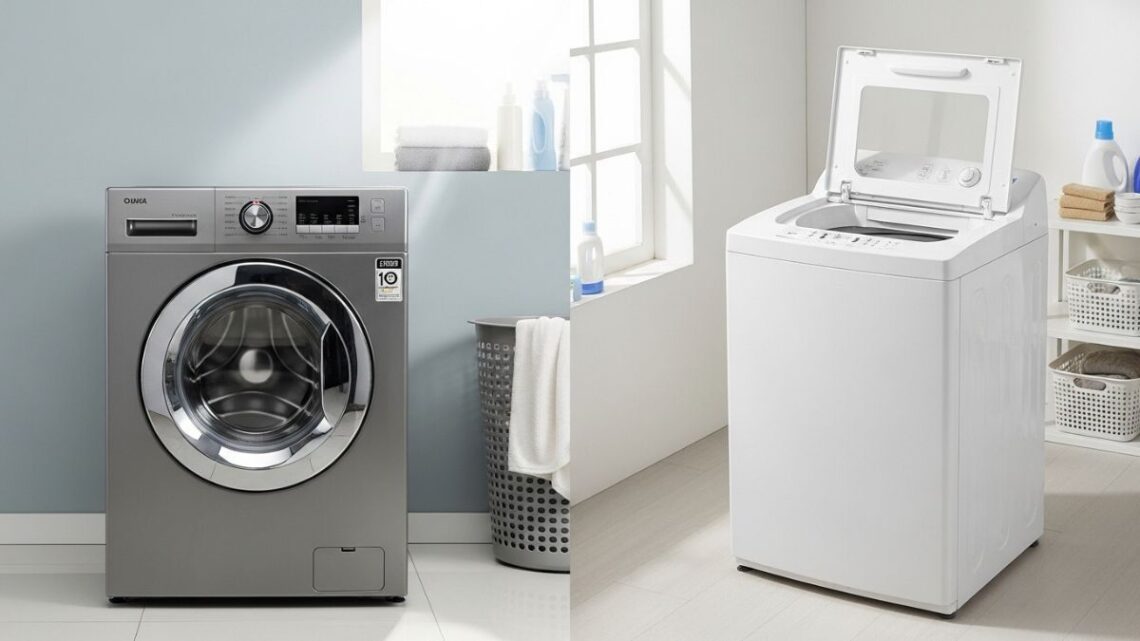
For most Indian homes, a front-load washing machine is the better long-term choice if you face water scarcity, live in a small apartment, or wash delicate ethnic wear. A top-load machine wins instead if your budget is under ₹25,000, your area has hard water, or you need to add forgotten clothes mid-cycle.
If you’ve read three “front load vs top load” articles already and still can’t decide, it’s probably because most comparisons list every possible spec instead of telling you which specs actually matter for your situation. This one skips straight to that.
Quick Comparison
| Factor | Front-Load | Top-Load |
| Water use (per load) | 40-60 litres | 80-120 litres |
| Wash cycle time | 60-120 minutes | 30-60 minutes |
| Price (6-7 kg) | ₹25,000-45,000 | ₹10,000-25,000 |
| Hard water tolerance | Needs softener | Handles it well |
| Fabric care | Gentler, better for delicates | Fine for everyday cotton |
| Add clothes mid-cycle | No (door locks) | Yes |
| Loading position | Bend down | Stand upright |
The Trade-Offs That Actually Decide This
Water and electricity favor front-load, clearly. A front-loader uses roughly 40-60 litres a load against 80-120 for a top-loader. Over a year, that’s a meaningful difference if you’re on a metered water connection or live somewhere water gets scarce in summer. Front-loaders also spin faster (1000-1400 RPM vs 600-800 RPM), which means less time in the dryer or on the drying rack too.
Hard water changes the calculation completely, and this is the part most comparison articles skip. A large share of Indian households deal with hard water, and front-loaders are genuinely more vulnerable to scaling on the drum and heating element from it. If you’re not already using a water softener, factor that cost in before assuming front-load is the “better” choice. For many hard-water households, top-load is actually the more practical pick, not just the cheaper one.
Fabric care leans front-load, but only matters if you have fabrics that need it. The gentler tumbling action is genuinely better for silk, delicate embroidery, and baby clothes. If your laundry is mostly everyday cotton and synthetic wear, this advantage won’t mean much to you in practice.
Convenience and speed belong to top-load. Shorter cycles, no bending to load or unload, and the ability to toss in a forgotten sock mid-wash: small things, but they add up daily, especially in households with young kids or elderly members.
Space works in front-load’s favor for small homes. It’s stackable with a dryer, fits under a counter, and has a smaller footprint, genuinely useful in a compact apartment where every square foot of the utility area counts.
Cost is a genuine trade-off, not a clear winner. Front-load costs 60-80% more upfront but typically pays that back over 3-5 years through lower water, electricity, and detergent-if-you-use-HE-formula costs. If you’re planning to stay in your current home for under 3 years, that breakeven math often doesn’t favor upgrading.
Energy rating matters more than the type itself. Whichever you choose, a 4 or 5-star BEE rating cuts running cost noticeably compared to a 2 or 3-star model of the same type. If lowering your power bill is the main goal, check the star rating label before checking front-load vs top-load.
A Simple Way to Decide
Answer these three questions honestly:
- Is your water hard, and do you have (or plan to get) a softener? If no softener and hard water, lean top-load.
- Is ₹25,000+ comfortably within budget right now? If not, top-load, without guilt. It’s not the “lesser” choice, just the more budget-matched one.
- Do you regularly wash delicates, baby clothes, or have serious space constraints? If yes to either, front-load earns its higher price.
If your answers split, the tie-breaker is usually water: in a genuine water-scarce area, front-load’s savings compound every single month, which usually outweighs everything else on this list.
Two Myths Worth Clearing Up
“Front-loaders always smell bad.” Only with poor maintenance. Leaving the door slightly ajar after each wash and a monthly drum clean prevents this almost entirely. It’s a habit issue, not a design flaw.
“Top-loaders can’t clean as well.” They clean fine, the agitator or impeller just uses friction instead of tumbling. Agitator models can be a bit harder on fabric over time, but claims that top-load is “worse” at cleaning aren’t accurate.
Quick Checklist Before You Buy
- Check your water hardness before deciding. Call your municipal supplier or test with a simple kit if unsure
- Measure your utility space, including clearance for a top-loader’s lid to open fully
- Add softener cost (if needed) to a front-loader’s real price before comparing
- Factor in your family’s laundry habits. Frequent mid-cycle additions favor top-load
- Compare BEE star ratings, not just base price, for a fairer running-cost picture
Final Thought
There’s no universally “better” machine here, only the one that matches your water quality, budget, and daily laundry habits. If you’re still unsure after the three questions above, go stand in your own utility area, picture your actual routine there, and let that decide it rather than a spec sheet.
Frequently Asked Questions
Which is better for Indian homes: front-load or top-load?
It depends on your water hardness and budget more than anything else. Front-load suits water-scarce, soft-water urban homes; top-load suits hard-water areas and tighter budgets.
Do front-load machines really save money over time?
Yes, typically ₹3,000-5,000 a year on water and electricity, but the higher purchase price usually takes 3-5 years to earn back. It matters most if you’ll stay put that long.
Which lasts longer, front-load or top-load?
Top-load machines average slightly longer (12-18 years vs 10-15), mainly due to simpler mechanics, but a well-maintained front-loader easily reaches its expected lifespan too.
Can I use regular detergent in a front-load machine?
No, front-loaders need low-suds/HE detergent. Regular detergent over-foams, leaves residue, and can damage the machine over time.
Is a front-load machine a bad idea in a hard water area?
Not a bad idea, but factor in a water softener’s cost first. Without one, scaling can shorten the machine’s lifespan and increase repair costs.
How much does a 6-7 kg washing machine cost in India?
Top-load models in this size typically range ₹10,000-25,000, while front-load ranges ₹25,000-45,000. Prices shift with brand, wash programs, and RPM, so treat these as a starting range for budgeting.