
Disclaimer: This article may contain affiliate links. If you purchase through these links, I may earn a small commission as an Amazon Associate—at no additional cost to you.
Lakshmi Puja is the centre of Diwali in most homes, performed on the evening of the new moon in Kartik. This year it falls on Sunday, 8 November (PanchangBodh).
You do not need a priest or a large puja room to do it well. This guide gives you a samagri list you can check off, a simple way to set up the chowki in a small space, and the usual order of worship. Families follow different traditions, so treat this as a framework and keep anything your family does differently.
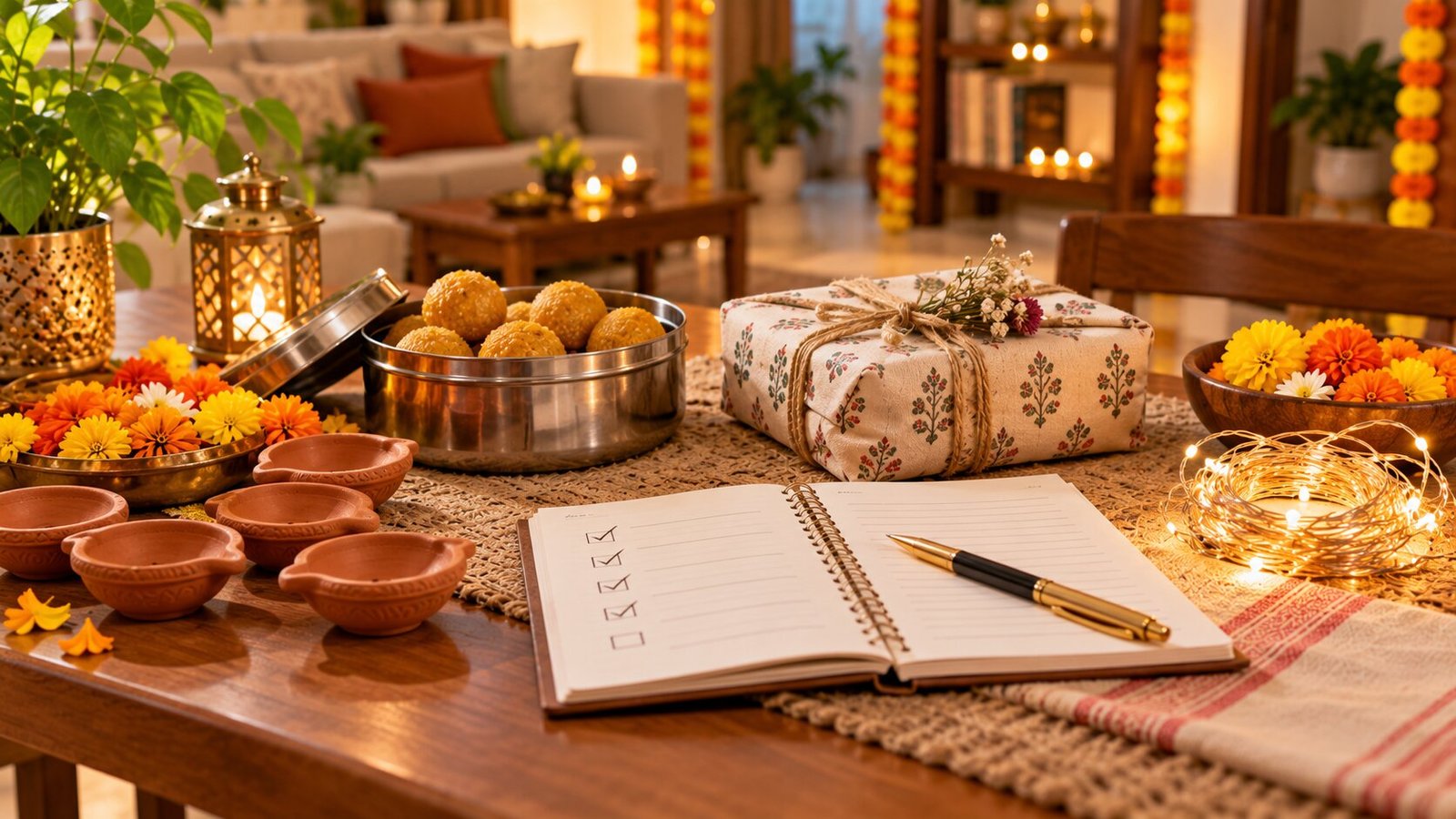
It fits into the final week of our Diwali preparation checklist.
Lakshmi Puja muhurat by city
Lakshmi Puja is done in the pradosh kaal, the period that begins at sunset. The muhurat within it depends on your city’s sunset, so it shifts from place to place. Amavasya tithi begins at 11:27 AM on 8 November and ends at 12:31 PM on 9 November (Drik Panchang).
| City | Lakshmi Puja muhurat (IST) |
|---|---|
| New Delhi | 5:54 PM to 7:50 PM |
| Mumbai | 6:27 PM to 8:27 PM |
| Bengaluru | 6:17 PM to 8:20 PM |
| Chennai | 6:07 PM to 8:09 PM |
| Kolkata | 5:20 PM to 7:18 PM |
| Hyderabad | 6:07 PM to 8:08 PM |
| Pune | 6:24 PM to 8:24 PM |
| Ahmedabad | 6:22 PM to 8:20 PM |
| Jaipur | 6:03 PM to 7:59 PM |
| Chandigarh | 5:52 PM to 7:46 PM |
Source: Drik Panchang Lakshmi Puja timings, which lets you pick any other city. Some families also do the puja at night in the nishita kaal, which Drik Panchang lists on the same page.
Lakshmi Puja samagri list
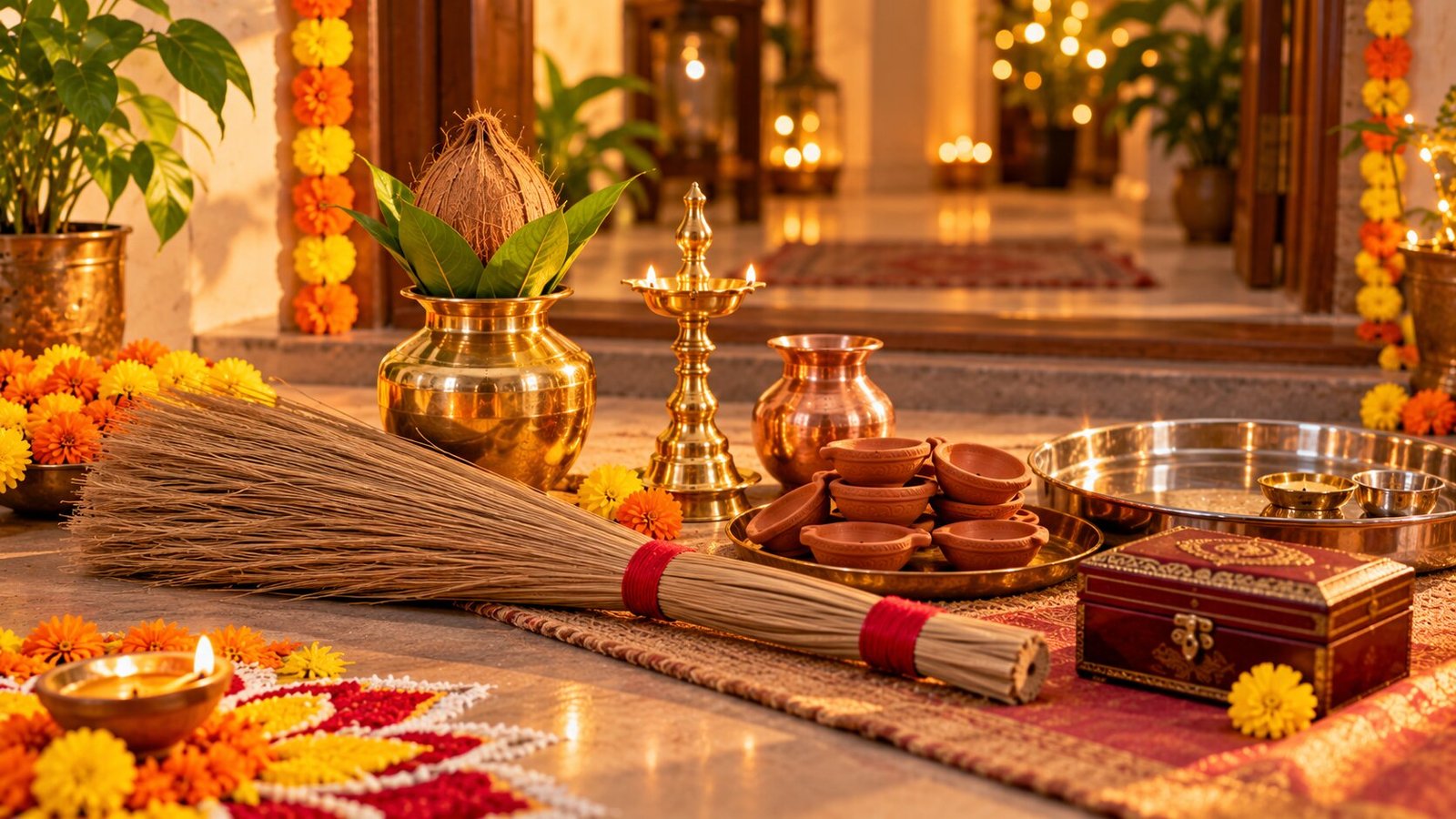
Gather everything a day ahead and keep it on one tray so nothing is missing once you sit down.
For the setup
- A low wooden chowki or a clean stool
- A red or yellow cloth to cover it
- Lakshmi and Ganesha idols or a framed picture
- A kalash (copper, brass or steel) filled with water
- Five mango leaves and a coconut for the kalash
- Moli (red thread)
- A thali for the puja items, and a separate aarti thali
For the offerings
- Kumkum, haldi and chandan
- Akshat (unbroken rice)
- Fresh flowers and a garland, lotus if you can find one
- Durva grass for Ganesha
- Supari and paan leaves
- Coins
- Kheel and batashe
- Sweets for naivedya, often kheer or ladoo
- Fruits
- Dhoop or incense sticks
For the lamps
- A main diya with ghee for the puja
- Clay diyas with oil and cotton wicks for the house, usually an odd number such as 11 or 21 (PanchangBodh)
- Camphor for the aarti
- A matchbox and a small bell
If your family does chopda pujan
Business families often place new account books on the chowki and worship them, so the new year’s accounts begin with Lakshmi’s blessing (PanchangBodh). Keep the books, a pen and kumkum ready if you follow this.
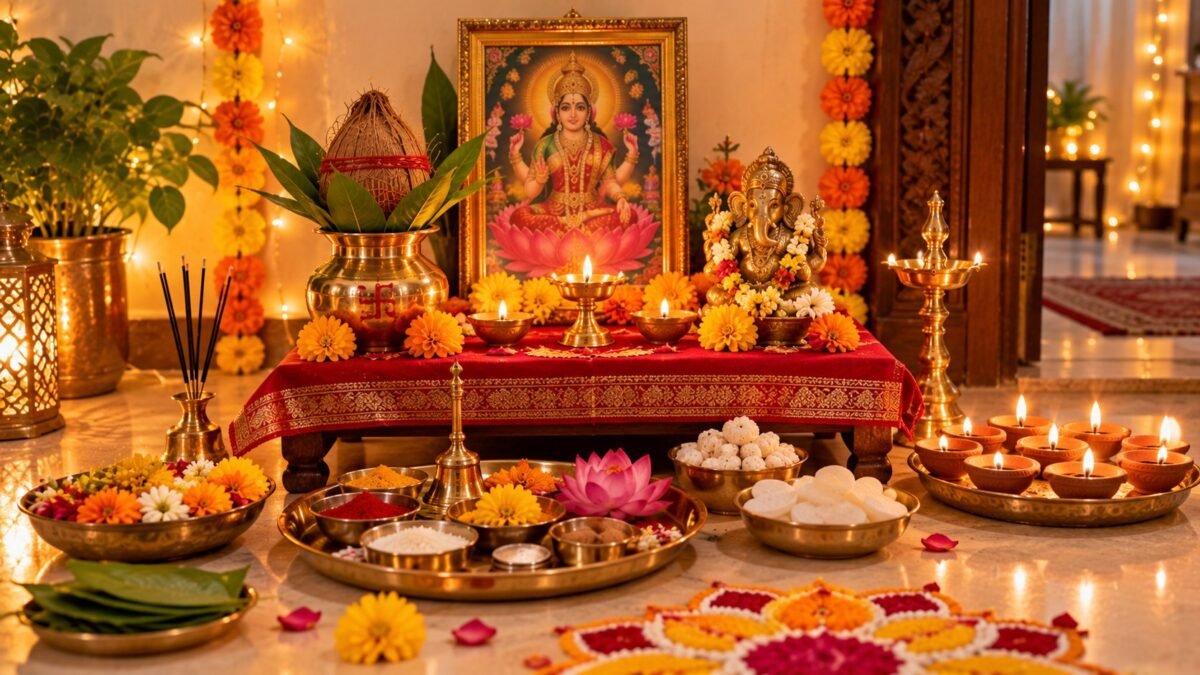
Setting up the chowki
- Clean the puja area during the day. Many families draw Lakshmi’s footprints in rice flour from the entrance to the puja corner.
- Place the chowki facing east or north if you can, so you sit facing that direction (Ved Panchang).
- Cover it with the red cloth.
- Place Lakshmi in the centre and Ganesha to her left (PanchangBodh).
- Set the kalash beside them: fill it with water, add a coin, a little rice and a supari, arrange the mango leaves at the mouth, place the coconut on top and tie moli around the neck.
- Arrange the puja thali, the diyas and the naivedya within easy reach.
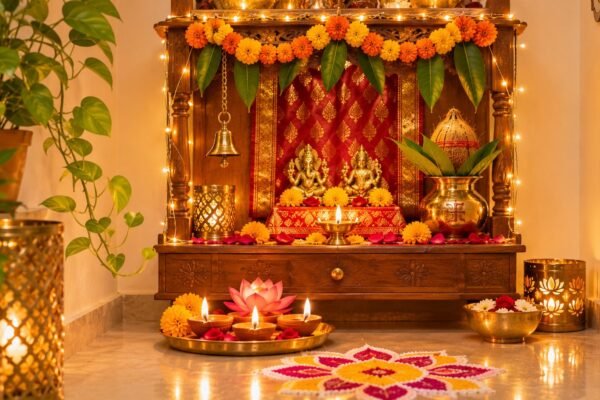
In a small flat, a cleared side table or the top of a low cabinet works as well as a chowki. Keep the diyas on a metal plate rather than directly on wood or cloth, and keep at least one clear side so no one has to reach over a flame. Our puja room organisation ideas include wall-mounted mandirs and storage for small homes, and our guide to puja room decoration for Diwali covers flowers, torans and lighting. For the rest of the home, see our Diwali decoration ideas for small homes.
If your brass diyas and silver items need cleaning first, our guide to cleaning brass and silver puja items explains which method suits which piece.
Lakshmi Puja vidhi: the order of worship
The steps below follow the order most households use. Ved Panchang and PanchangBodh both note that practice varies by region and family, so follow your own tradition where it differs (Ved Panchang, PanchangBodh).
1. Prepare yourself and the space
Bathe, wear clean clothes, and light the main ghee diya. Sprinkle a little water over the samagri and around the chowki.
2. Sankalp
Sit facing east or north. Hold a little water, akshat and a flower in your right hand, state your name, your family’s gotra if you use it, the place and the purpose of the puja, then release them onto a plate (Ved Panchang).
3. Kalash puja
Offer kumkum, akshat and a flower to the kalash.
4. Ganesha puja
Ganesha is worshipped before Lakshmi as the remover of obstacles (PanchangBodh). Offer durva, a red flower, chandan, akshat and a sweet.
5. Lakshmi puja
Invite Lakshmi with a flower, ideally a lotus. Then make the offerings in turn: water, kumkum and haldi, chandan, akshat, flowers and the garland, dhoop, the lamp, naivedya and fruit, and paan with supari. This sequence of offerings is known as shodashopachara, the sixteen offerings. Many families keep coins and jewellery before the goddess during this step.
Families who worship Kubera, and Saraswati, do so alongside Lakshmi at this point (PanchangBodh).
6. Prayers and mantras
Recite whatever your family uses. Ved Panchang lists the Shri Suktam and the Kanakadhara Stotra as common choices (Ved Panchang). Even a short prayer in your own words is fine.
7. Chopda pujan
If you follow it, place the account books on the chowki, mark them with kumkum and offer akshat and a flower.
8. Aarti
Light the camphor in the aarti thali and perform the aarti of Ganesha and Lakshmi, circling clockwise. Take your time over it.
9. Light the diyas
After the puja, light diyas at the entrance, on windowsills and near every door, so no threshold is left dark (PanchangBodh).
10. Prasad
Offer a final flower, then share the naivedya with the family and, if you like, neighbours. Many families keep a small diya burning overnight.
Diya and lamp safety
Diyas, camphor and incense all mean open flames in a small space, often near curtains, flowers and festive clothes. Dorset and Wiltshire Fire and Rescue, which publishes Diwali safety advice for its local communities, recommends the following (DWFRS Diwali safety):
- Use proper holders, and keep diyas away from curtains, decorations and clothing.
- Keep them out of children’s reach.
- Use only as much oil or ghee as the diya needs for the puja.
- Tie back dupattas, saree pallus and long sleeves when lighting lamps.
- Put out diyas when you leave the room or go to bed, or use LED tea lights for anything that must stay lit.
After the puja
Leave the flowers and kalash in place for the night if that is your family’s custom. The next day, compost the flowers and garlands, and wipe the diyas while the oil is still soft. Our post-Diwali cleaning guide covers removing oil and wax from floors and packing diyas for next year.
Frequently asked questions
Can I do Lakshmi Puja at home without a priest?
Yes. Many families perform it themselves, and the steps above are written for a household to follow. If your family has a priest or elder who usually guides the puja, ask them about any steps specific to your tradition.
What time should Lakshmi Puja be done?
In the pradosh kaal after sunset. The exact muhurat depends on your city; this year it falls between roughly 5:20 PM and 8:30 PM IST across the major cities listed above.
Where should Ganesha be placed in Lakshmi Puja?
To Lakshmi’s left, and he is worshipped first.
How many diyas should I light on Diwali?
Families usually light an odd number, such as 11 or 21. What matters more is that they are placed safely and that no entrance or window is left dark.
What do I do if I do not have a lotus?
Use any fresh red or pink flower. The offering matters more than the specific flower.
Sources
- PanchangBodh, Diwali Lakshmi Puja vidhi
- Ved Panchang, Diwali puja vidhi
- Drik Panchang, Lakshmi Puja timings
- Dorset and Wiltshire Fire and Rescue Service, Diwali safety