Puja Room Organization Ideas Before Navratri: Small-Space Solutions for Indian Homes
Disclaimer: This article may contain affiliate links. If you purchase through these links, I may earn a small commission as an Amazon Associate—at no additional cost to you.
The best puja room organization ideas for small Indian homes center on wall-mounted mandirs, which free up floor space entirely, paired with dedicated small-drawer storage for diyas, incense, and puja thalis. A compact unit costs anywhere from ₹3,000 for a basic MDF shelf to ₹90,000 for a custom corner installation, depending on size and material.
With Navratri approaching, this is exactly the week most families start thinking about this. In a 2024 LocalCircles survey of nearly 13,000 respondents, 70 percent of Indian households said they planned to spend on pooja supplies like diyas, lamps, candles, and flowers during the festive season, which means the puja space itself needs to be ready to actually hold everything. If your current setup is a cramped shelf with wax drippings and tangled incense packets, here’s how to fix it without needing a spare room you don’t have.
Small-Space Mandir Solutions That Actually Work
Wall-Mounted Mandirs: The Default Choice for Rented 1BHKs
If you’re renting a 1BHK in a city like Pune or Bangalore and can’t commit to a permanent structure, a wall-mounted mandir is usually where people land first, and for good reason. These units fix directly to the wall, so the floor underneath stays completely free, which matters when your living room is already doing double duty as a dining space.
Basic MDF versions start around ₹3,000 to ₹4,000 on sites like Nestasia and Amazon.in, usually including a pull-out slab and a small storage drawer underneath. Step up to a solid wood version with a proper backlit niche and you’re looking at ₹8,000 to ₹15,000.
The real trade-off here is permanence. Drilling into a rented wall needs landlord sign-off, and the surface area is genuinely limited, so if your family worships multiple deities with separate idols, a single wall shelf gets crowded fast. It’s the right call for solo or couple households with modest needs, not for a joint family puja setup.
Corner Pooja Units: More Presence, More Commitment
Where a wall-mounted mandir is about minimal footprint, a corner unit is about giving the space actual visual weight, floor to near-ceiling, built into two intersecting walls.
This costs more, typically ₹35,000 to ₹90,000 when it’s part of a larger carpentry job, and it needs real floor clearance, so it’s not the answer if your “puja corner” is genuinely a 2-foot gap between the sofa and the window. But if you have even a modest 2BHK with one underused corner, this gives you a proper dedicated space without sacrificing an entire room,, and because it is built in, it gives the family a defined worship corner without taking over a whole room.
Cabinet-Style Units With Jaali Doors: For When You Want to Close It Off
Here’s a mistake a lot of first-time apartment owners make: they install an open-shelf mandir, then realize they want to close it during non-puja hours, especially if the unit sits near the kitchen and picks up cooking smells, or if guests are over and the space feels too exposed.
A cabinet-style unit with carved jaali (lattice) doors solves this. You get the same wall-mounted or corner footprint, but with doors that close the shrine away when it’s not in active use, which also helps if you’re keeping flowers or prasad inside that you don’t want flies getting to overnight. The downside is cost and lead time, custom jaali work usually adds a few thousand rupees over a plain-door version and takes longer to source than an off-the-shelf unit you can order same-week on Amazon.in.
Foldable and Portable Mandirs: Best for Homes You Won’t Stay In Long
If you move every two to three years, which is common for renters in IT-hub cities, a fixed wall-mounted or corner unit is a sunk cost you’ll have to leave behind or awkwardly uninstall. Portable, foldable mandirs, usually a wooden box-style unit with doors that shut flat, solve this specifically. You can pack it with the rest of your furniture and set it up again in the next home without any wall work at all.
The honest trade-off is that these look noticeably less premium than a built-in unit, and serious Vastu followers sometimes feel a portable mandir lacks the permanence a worship space is meant to have. It’s a practical choice for transience, not a long-term upgrade.
The Part Everyone Forgets: Storing the Actual Puja Items
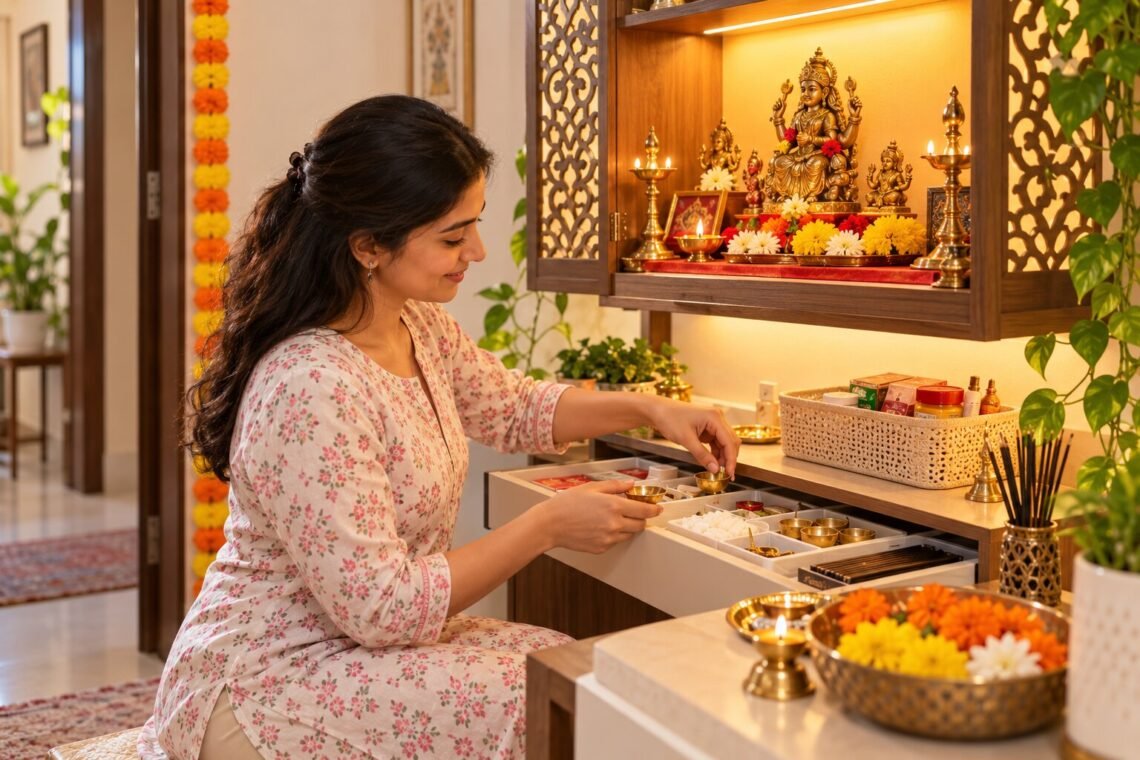
A mandir unit solves where the idols go. It doesn’t automatically solve where the diyas, extra wicks, incense packets, matchboxes, and puja thali live, and this is usually the actual daily friction point, not the mandir itself.
A few specific fixes that work in Indian puja corners:
- A shallow drawer insert (many wall-mounted units already include one, but a ₹150 to ₹300 plastic drawer organizer from Amazon.in works just as well retrofitted into an existing cabinet) keeps loose diyas and matchboxes from rolling around
- A small wicker or steel basket, kept just below or beside the mandir, holds extra incense packets and camphor so they’re not sitting loose on the shelf itself
- Keep the puja thali hung on a small wall hook right beside the unit rather than stored inside it, since it needs to come out daily and digging through a closed drawer every morning gets old fast
- A small steel or glass jar with a tight lid keeps loose kumkum, haldi, and akshat (rice) from spilling into the drawer with everything else, which is a common complaint once a drawer has been in daily use for a few months
- If the unit sits near a window, a small removable tray under the diyas catches wax drippings and makes cleanup a wipe-down instead of a scrape-off job
Material Matters More Than Most People Realize
MDF and solid wood both show up constantly in wall-mounted mandir listings, and the price gap between them (₹3,000 for MDF versus ₹8,000 to ₹15,000 for solid wood) makes MDF tempting by default. The trade-off worth knowing before you buy: MDF is pressed wood fiber held together with resin, and in genuinely humid coastal cities, Mumbai, Chennai, Kochi, sustained monsoon moisture is the condition MDF furniture in general handles worse than solid wood, since swelling and edge lifting over repeated humid seasons is a commonly reported issue with pressed-wood furniture in these climates. Drier cities inland, Pune, Bangalore, Delhi, don’t put the same stress on it. If you’re in a coastal city and planning to keep the unit for more than a few years, the extra spend on solid wood or a well-sealed laminate finish is the kind of detail that only shows up as a problem two monsoons later, not on day one.
Common Mistakes Worth Avoiding
A few mistakes are easy to make when you are buying under time pressure before a festival, so it is worth flagging them before you commit to a unit:
Buying based on the showroom photo alone, without measuring your actual wall space first. A unit that looks compact in a large showroom display can still be too wide for a narrow apartment corridor wall, and returns on custom or made-to-order units are often difficult or impossible.
Overcrowding a small unit with too many idols, photo frames, and decorative items at once. Vastu guidance generally advises keeping the space uncluttered rather than treating it as a display shelf, and practically, a crowded shelf also makes daily cleaning harder, which matters most during Navratri when the space gets used more often than usual.
Placing the mandir directly facing the main entrance door. This is a specific placement mistake flagged repeatedly in Vastu guidance, since it’s considered to let the home’s positive energy exit straight back out the door it just entered through.
Skipping ventilation. A closed cabinet-style unit with jaali doors looks elegant, but if incense and diya smoke have nowhere to vent, soot buildup on the inside panels happens faster than people expect, especially with daily use rather than occasional festival use.
Choosing by Budget, Not Just by Size
If you are deciding between options in the last week before Navratri, budget usually narrows the choice faster than floor space does. Under ₹5,000, a basic MDF wall-mounted unit is realistic and can usually be ordered online with delivery in a few days. Between ₹8,000 and ₹15,000, solid wood wall-mounted units with a backlit niche open up. Anything above ₹35,000 generally means custom carpentry for a corner unit or cabinet, which rarely finishes in a week, so if Navratri is close, plan on a ready-made unit now and a custom upgrade later.
One practical tip: measure the wall width, the height from the floor, and the distance to the nearest switchboard or window before you order. Keep the unit at least a hand’s width away from switchboards, and never mount it where diya flames can reach a curtain or loose cloth.
Where to Place It: The Basics Worth Knowing
Vastu guidance consistently points to the northeast corner of the home as the ideal direction for a puja space, with the idols facing east or west so the person praying faces east. In a small apartment where the northeast corner is already occupied, kitchen-facing walls near the dining area are the next most common compromise, since they keep the space central without requiring a dedicated room. Avoid placing the mandir directly opposite a bathroom door or under a staircase, both are commonly flagged as poor placement in Vastu guidance regardless of how much space you’re working with.
Your Quick-Reference Checklist
- Renting or tight on space: wall-mounted mandir, ₹3,000 to ₹15,000 depending on finish
- Have a spare corner in a 2BHK: corner pooja unit, ₹35,000 to ₹90,000
- Want to close the shrine away when not in use: cabinet-style unit with jaali doors
- Move frequently: foldable or portable mandir
- Don’t forget: a drawer or basket specifically for diyas, incense, and matchboxes
- Hang the puja thali on a hook beside the unit, not inside a closed drawer
- Placement: northeast corner ideal, kitchen-facing dining wall as a practical second choice
Conclusion
A small apartment doesn’t rule out a proper puja space, it just changes which solution makes sense. Wall-mounted units solve it for renters, corner units for homes with a spare footprint, and a dedicated drawer or basket solves the part most people forget entirely: where the actual diyas and incense live day to day. Pick the version that matches how long you’re staying and how much daily use the space gets, and the rest falls into place well before Navratri arrives.
Frequently Asked Questions
What’s the cheapest way to set up a puja space in a small apartment?
A basic MDF wall-mounted mandir starting around ₹3,000 to ₹4,000 is the most affordable option, and it needs no floor space at all.
Can I install a wall-mounted mandir in a rented flat?
Yes, but you’ll need landlord permission for drilling. Some renters use strong adhesive wall hooks for lighter units instead of screws.
How do I keep incense and diyas from cluttering the puja shelf?
Add a small drawer organizer or a wicker basket specifically for these items, kept separate from the idols themselves.
Is a corner pooja unit better than a wall-mounted one?
It’s not strictly better, it gives more visual presence and storage but costs more and needs actual floor clearance a wall-mounted unit doesn’t require.
What direction should the puja room face according to Vastu?
The northeast corner of the home is considered ideal, with idols facing east or west so the person praying faces east.
Are foldable mandirs disrespectful or just practical?
They’re a practical choice, especially for frequent movers, though some families prefer a permanent fixture for the sense of stability it gives the worship space.